
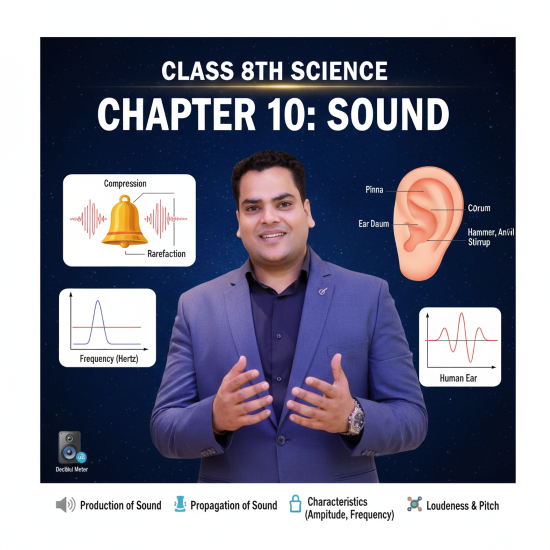
Chapter 10: Sound
Chapter 10: Sound
1. Introduction to Sound
- Sound is a form of energy that produces a sensation of hearing in our ears.
- Sound is produced by vibrating objects. Example: When a drum is beaten, its surface vibrates and produces sound.
- Sound cannot travel through vacuum (empty space). It needs a material medium (solid, liquid, or gas) to travel.
- Experiment: Bell-jar experiment – When an electric bell is rung inside a vacuum jar, no sound is heard when air is removed → proves sound needs a medium.
2. How Sound is Produced
- Vibration: To and fro or back and forth motion of an object.
- Every vibrating body produces sound. Example: Stretched rubber band, tabla, flute, vocal cords.
- Human voice: Sound is produced when air from lungs makes vocal cords vibrate.
3. Propagation of Sound (How Sound Travels)
- Sound travels as a longitudinal wave.
- Longitudinal wave: Particles of the medium vibrate parallel to the direction of wave propagation.
- Parts of a longitudinal wave:
- Compression (C): Region of high pressure and high density.
- Rarefaction (R): Region of low pressure and low density.
- Sound travels fastest in solids > liquids > gases because particles are closest in solids.
- Speed of sound in air ≈ 340–350 m/s (at room temperature).
4. Characteristics of Sound Waves
Sound can be described by three main characteristics:
| Characteristic | Meaning | Depends on | Unit |
|---|---|---|---|
| Amplitude | Maximum displacement of vibrating particles | Energy/Loudness of sound | metre (m) |
| Frequency | Number of vibrations per second | Source of sound (how fast it vibrates) | Hertz (Hz) |
| Waveform/Quality | Shape of the wave | Type of source (gives timbre) | – |
5. Terms Related to Sound
- Loudness: Sensation of how strong or weak a sound is. Depends on amplitude.
- Larger amplitude → louder sound.
- Pitch: How high or low the sound is. Depends on frequency.
- Higher frequency → higher pitch (shrill sound, e.g., female voice, whistle).
- Lower frequency → lower pitch (deep sound, e.g., male voice, drum).
- Quality (Timbre): Characteristic that helps us distinguish between sounds of same loudness and pitch produced by different sources (e.g., guitar vs flute).
- Noise: Unpleasant, irregular, and loud sound.
- Music: Pleasant, regular, and soothing sound.
6. Human Ear – How We Hear Sound
Structure of human ear (simplified):
- Outer ear (Pinna) → collects sound waves.
- Ear canal → sound travels to eardrum.
- Eardrum → vibrates when sound waves hit it.
- Middle ear → three tiny bones (hammer, anvil, stirrup) amplify vibrations.
- Inner ear (Cochlea) → converts vibrations into electrical signals.
- Auditory nerve → carries signals to brain → we perceive sound.
7. Audible, Infrasonic, and Ultrasonic Sounds
| Type | Frequency Range | Heard by Humans? | Examples |
|---|---|---|---|
| Audible | 20 Hz to 20,000 Hz (20 kHz) | Yes | Normal speech, music |
| Infrasonic | Below 20 Hz | No | Earthquake, volcanic eruptions, whales |
| Ultrasonic | Above 20,000 Hz (20 kHz) | No | Bats, dolphins, ultrasound machines |
- Some animals can hear infrasound (elephants) and ultrasound (bats, dogs).
8. Reflection of Sound and Echo
- Sound gets reflected from hard surfaces following the same laws as light (angle of incidence = angle of reflection).
- Echo: Reflected sound heard distinctly after the original sound. Conditions for hearing a clear echo:
- Reflecting surface should be large and hard.
- Distance between source and reflector ≥ 17 m (in air at 340 m/s, time gap ≥ 0.1 second).
- Reverberation: Repeated reflection of sound causing persistence of sound (heard in empty halls). Reduced by carpets, curtains, etc.
9. Uses of Reflection of Sound
- Megaphones, loudspeakers, horns – designed to send sound in a particular direction.
- Stethoscope – sound of heartbeat travels through the tube by multiple reflections.
- Soundboards – curved surfaces behind speaker reflect sound evenly in auditoriums.
10. SONAR (Sound Navigation and Ranging)
- Technique to measure depth of sea or locate underwater objects using ultrasonic waves. Working:
- Ultrasonic waves are sent from ship → reflected from seabed → echo received.
- Time interval (t) between sending and receiving is noted.
- Speed of sound in seawater (v) ≈ 1500 m/s.
- Distance/depth = (speed × time)/2 (divided by 2 because sound travels to object and back).
11. Applications of Ultrasound
- Cleaning delicate objects (jewellery, machine parts).
- Detecting cracks in metal blocks.
- Echocardiography (heart examination).
- Ultrasonography (imaging of foetus).
- Breaking kidney stones (lithotripsy).
12. Noise Pollution
- Causes:
- Factories, vehicles, loudspeakers, bursting crackers, machines.
- Harmful effects:
- Hearing impairment or deafness.
- Lack of sleep, hypertension, anxiety.
- Physiological and psychological stress.
- Control measures:
- Use of silencers in vehicles.
- Planting trees along roads.
- Following noise level limits.
- Avoiding loud music and horns.
Important Points to Remember
- Sound cannot travel in vacuum.
- Sound travels as longitudinal waves (compression and rarefaction).
- Speed of sound: solids > liquids > gases.
- Frequency determines pitch, amplitude determines loudness.
- Humans hear 20 Hz to 20 kHz only.
- Minimum distance for echo = 17 m (in air).
- SONAR uses ultrasound for underwater distance measurement.
- Excessive noise is harmful; we must reduce noise pollution.
Quick Revision Table
| Medium | Speed of sound (approx.) |
|---|---|
| Air | 340 m/s |
| Water | 1480 m/s |
| Steel | 5000–6000 m/s |
Download pdf notes and Sulutions of the Chapter:
Please Visit Readspot for Hindi Medium Study Material
Tag:Sound

You may also like

Chapter 1: Crop Production and Management
26 November, 2025

Chapter 2: Microorganisms Friend and Foe
26 November, 2025

Chapter 3: Coal and Petroleum
26 November, 2025