
Chapter 4: Combustion and Flame
CBSE Class 8 Science Chapter 4: Combustion and Flame
Introduction to Combustion and Flame:
These notes of Combustion and Flame, cover the entire chapter in concise form suitable for quick revision before exams. Practice diagrams of candle flame and fire triangle for better marks!
1. What is Combustion?
- Combustion is a chemical process in which a substance reacts rapidly with oxygen and gives off heat and light.
- The substance that undergoes combustion is called a combustible substance or fuel.
- Examples: Wood, charcoal, LPG, petrol, kerosene, CNG, cow-dung cakes, coal, magnesium, paper, etc.
- Substances that do not burn on being exposed to flame are called non-combustible substances. Examples: Stone, glass, iron nail, cement, sand, water, etc.
2. Conditions Necessary for Combustion
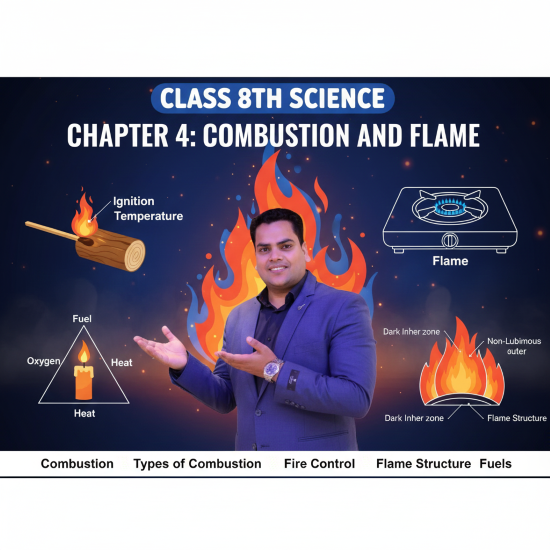
For combustion to take place, three things are essential (Fire Triangle):
- Presence of a combustible substance (Fuel)
- Presence of air (oxygen/supporter of combustion)
- Heating the combustible substance to its ignition temperature
- Ignition temperature: The lowest temperature at which a substance catches fire and starts burning.
- Below ignition temperature → no combustion.
- Substances with very low ignition temperature catch fire easily (e.g., phosphorus catches fire even at room temperature).
3. How Do We Control Fire?
- By cutting off any one side of the fire triangle:
- Remove fuel → fire goes out.
- Cut off air supply → cover with blanket, sand, or use CO₂ extinguisher.
- Bring temperature below ignition temperature → spray water (but not on oil or electrical fires).
Note: Water is not used for:
- Oil fires → oil floats on water and fire spreads.
- Electrical fires → water conducts electricity → danger of shock.
- In such cases, CO₂ extinguishers are used.
4. Types of Combustion
- Rapid combustion: Combustion in which a substance burns rapidly and produces heat and light quickly. Example: Burning of LPG in gas stove, matchstick.
- Spontaneous combustion: Combustion that occurs on its own without external heating when ignition temperature is reached. Example: Phosphorus catches fire in air at room temperature; forest fires due to heat buildup in dry leaves.
- Explosion: A very fast combustion that releases large amount of heat, light, and sound with sudden increase in volume. Example: Firecrackers, sudden leakage of LPG cylinder.
- Slow combustion: Combustion that proceeds slowly without visible flame or light (may produce heat only). Example: Respiration in our body, rusting of iron.
5. Flame
- Flame is the visible, gaseous part of fire where combustion occurs.
- Only substances that vaporize on heating produce a flame (e.g., candle wax, kerosene).
- Substances like coal, charcoal do not produce flame; they only glow (become red hot).
Structure of a Candle Flame (Three Zones) (Observe when a matchstick is brought near different parts of the flame)
- Outermost zone (Blue zone)
- Hottest part
- Complete combustion occurs (plenty of oxygen)
- Non-luminous (least bright)
- Temperature: ~1400–1600 °C
- Middle zone (Luminous zone – Yellow)
- Moderately hot
- Partial combustion (less oxygen)
- Brightest part (glow of unburnt carbon particles)
- Soot is produced here
- Innermost zone (Dark zone)
- Least hot
- No combustion (no oxygen)
- Unburnt wax vapours + carbon particles → black
- Temperature: ~600–800 °C
- Wax vapours rise → burn in luminous zone → carbon particles get heated and glow → reach outermost zone → burn completely.
6. Fuels
- Fuels are substances that produce heat and light energy on burning.
- Good fuel should have:
- High calorific value
- Low ignition temperature
- Moderate rate of combustion
- Less smoke and non-poisonous products
- Easy availability and low cost
Calorific Value: Amount of heat produced on complete combustion of 1 kg of fuel (unit: kJ/kg). Higher the calorific value → better the fuel.
| Fuel | Calorific Value (kJ/kg) |
|---|---|
| Hydrogen | 150000 |
| LPG | 55000 |
| CNG | 50000 |
| Biogas | 35000–40000 |
| Petrol/Diesel | 45000 |
| Kerosene | 45000 |
| Coal | 25000–33000 |
| Wood | 17000 |
| Cow-dung cake | 6000–8000 |
7. Types of Fuels
- Solid fuels: Coal, wood, charcoal, coke, cow-dung cakes.
- Liquid fuels: Petrol, diesel, kerosene, alcohol.
- Gaseous fuels: CNG, LPG, biogas, hydrogen, coal gas.
Advantages of gaseous fuels:
- High calorific value
- No ash
- Complete combustion
- Easy transport through pipelines
8. Burning of Fuels Leads to Harmful Products
- Incomplete combustion produces:
- Carbon monoxide (CO) → poisonous gas, causes suffocation.
- Soot (unburnt carbon particles) → causes respiratory problems, global warming.
- Burning of coal and petroleum → CO₂, SO₂, NO₂ → acid rain, global warming.
- Oxides of nitrogen and sulphur → respiratory diseases, acid rain.
9. Flame Colours and Their Meaning
- Blue flame → complete combustion (clean burning)
- Yellow flame → incomplete combustion (produces soot, CO)
10. Fire Extinguisher
- Mostly uses CO₂ gas under pressure.
- CO₂ is heavier than air → blankets the fire → cuts off oxygen supply.
- Also cools down the burning substance.
11. Key Definitions
- Combustion: Chemical process of burning with oxygen producing heat and light.
- Ignition temperature: Lowest temperature at which a fuel catches fire.
- Inflammable substances: Substances with very low ignition temperature (e.g., petrol, alcohol, LPG).
- Calorific value: Heat produced by burning 1 kg of fuel completely.
Important Points to Remember (Exam Tips)
- Water cannot be used to extinguish fire caused by electricity or oils.
- Candle flame has three zones; outermost is hottest.
- Hydrogen has the highest calorific value.
- CO₂ extinguishes fire by displacing oxygen and cooling.
- Phosphorus is stored under water because its ignition temperature is below room temperature.
- Burning of fossil fuels increases CO₂ → global warming.
- Ideal fuel: High calorific value, low cost, no pollution, easy storage/transport.
Quick Revision Table
| Term | Meaning/Example |
|---|---|
| Combustible | Burns in air (wood, paper) |
| Non-combustible | Does not burn (stone, glass) |
| Ignition temperature | Minimum temp. to catch fire |
| Rapid combustion | Fast burning with flame (matchstick) |
| Explosion | Sudden combustion with sound (cracker) |
| Flame | Visible gaseous part (kerosene lamp) |
| Fuel | Substance that gives heat on burning (coal, LPG) |
| Calorific value | Heat released by 1 kg fuel (kJ/kg) |
Download pdf notes and Sulutions of the Chapter:
Please Visit Readspot for Hindi Medium Study Material

You may also like

Chapter 1: Crop Production and Management
26 November, 2025

Chapter 2: Microorganisms Friend and Foe
26 November, 2025
Chapter 3: Coal and Petroleum
26 November, 2025