Chapter 8: The Making of the National Movement
The Making of the National Movement: 1870s–1947
Introduction to the National Movement
The National Movement in India refers to the prolonged struggle against British colonial rule that gained momentum from the 1870s and culminated in independence in 1947. This National Movement was shaped by growing dissatisfaction with British policies, the rise of nationalism, and the participation of diverse groups. The National Movement began with educated Indians criticizing British rule and gradually involved masses from all sections of society. Understanding the phases of the National Movement helps us appreciate how India united for freedom.
Emergence of Nationalism in the 1870s–1880s
In the 1870s and 1880s, discontent against British rule intensified, laying the foundation for the National Movement. Laws like the Arms Act (1878) disallowed Indians from possessing arms, while the Vernacular Press Act (1878) gagged Indian newspapers critical of the government. The Ilbert Bill controversy (1883) exposed racial discrimination when Europeans opposed equal judicial rights for Indians. These events fueled criticism and marked the early stirrings of the National Movement. Political associations like the Poona Sarvajanik Sabha, Indian Association (1876), Madras Mahajan Sabha, and Bombay Presidency Association emerged, demanding reforms and greater Indian representation. These groups prepared the ground for a larger National Movement.
Formation of the Indian National Congress (1885)
A key milestone in the National Movement was the founding of the Indian National Congress (INC) in 1885 by A.O. Hume, with leaders like Dadabhai Naoroji, Surendranath Banerjee, and Gopal Krishna Gokhale. Initially, the INC acted as a moderate platform, petitioning for Indian participation in councils and civil services. Early sessions of the National Movement focused on constitutional reforms. By the early 1900s, the National Movement saw the rise of assertive nationalists (Extremists) like Bal Gangadhar Tilak, Bipin Chandra Pal, and Lala Lajpat Rai (Lal-Bal-Pal), who advocated Swadeshi, boycott of foreign goods, and self-reliance. Tilak’s slogan “Swaraj is my birthright” inspired the radical phase of the National Movement.
Swadeshi and Partition of Bengal (1905)
The Partition of Bengal by Lord Curzon in 1905 sparked widespread protests and intensified the National Movement. Seen as a “divide and rule” policy, it led to the Swadeshi and Boycott Movement, where Indians promoted indigenous goods and boycotted British products. This phase broadened the National Movement, involving students, women, and peasants. The National Movement gained momentum with the formation of the Muslim League in 1906, though it initially cooperated with Congress. The annulment of the partition in 1911 was a victory for the National Movement.
Advent of Mahatma Gandhi and Mass Nationalism
The National Movement transformed with Mahatma Gandhi’s return from South Africa in 1915. Gandhi introduced satyagraha (non-violent resistance) and made the National Movement truly mass-based. Early experiments like Champaran (1917), Kheda (1918), and Ahmedabad mill strike showed Gandhi’s approach. The Rowlatt Act (1919) allowed detention without trial, leading to protests and the Jallianwala Bagh massacre in Amritsar, where General Dyer ordered firing on unarmed crowds. This tragedy radicalized the National Movement.
Non-Cooperation-Khilafat Movement (1920–1922)
Gandhi linked the Khilafat issue (concerning the Turkish Caliph) with Indian demands, launching the Non-Cooperation Movement. People boycotted schools, courts, and foreign cloth; khadi was promoted. The National Movement saw massive participation, but violence at Chauri Chaura (1922) led Gandhi to call it off. Though withdrawn, it strengthened the National Movement by uniting Hindus and Muslims temporarily.
Revolutionary Activities and Civil Disobedience
Parallel to moderate efforts, revolutionaries like Bhagat Singh, Chandrashekhar Azad, and Subhas Chandra Bose contributed to the National Movement through armed actions. The Civil Disobedience Movement (1930) began with Gandhi’s Dandi March, breaking the salt law. Millions joined, defying salt taxes and facing arrests. Women played a prominent role, and the National Movement reached villages. The Gandhi-Irwin Pact (1931) temporarily suspended it, but it resumed briefly.
Towards Quit India and Independence (1930s–1947)
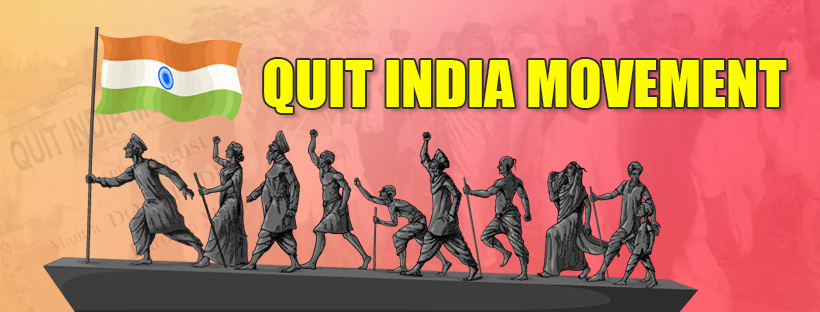
The 1930s saw the Government of India Act (1935) and provincial elections where Congress formed governments. The Muslim League’s demand for Pakistan grew after 1940 Lahore Resolution. World War II strained relations; Congress opposed India’s involvement without consultation. In 1942, the Quit India Movement demanded “Do or Die” for immediate independence. Mass arrests followed, but underground activities continued in the National Movement. Leaders like Jawaharlal Nehru, Sardar Patel, and Maulana Azad guided it. Post-war, the Cabinet Mission (1946) failed, leading to communal violence after Direct Action Day (1946). The National Movement faced partition pains, but Mountbatten Plan led to independence on August 15, 1947 (India) and August 14 (Pakistan).
Role of Different Groups in the National Movement
The National Movement was inclusive: peasants protested taxes, workers struck, women like Sarojini Naidu led, tribals joined, and businessmen supported Swadeshi. Figures like Khan Abdul Ghaffar Khan (Frontier Gandhi) showed non-violence in NWFP. The National Movement drew strength from unity despite divisions.
Conclusion: Legacy of the National Movement
The National Movement from 1870s to 1947 was a remarkable journey of unity, sacrifice, and non-violence led by Gandhi. It not only ended colonial rule but inspired global freedom struggles. The National Movement taught self-reliance, equality, and democracy, shaping modern India.
Download pdf notes and Sulutions of the Chapter:
Please Visit Readspot for Hindi Medium Study Material

You may also like
Chapter 6: Civilising the “Native”, Educating the Nation
Chapter 7: Women,Caste and Reform