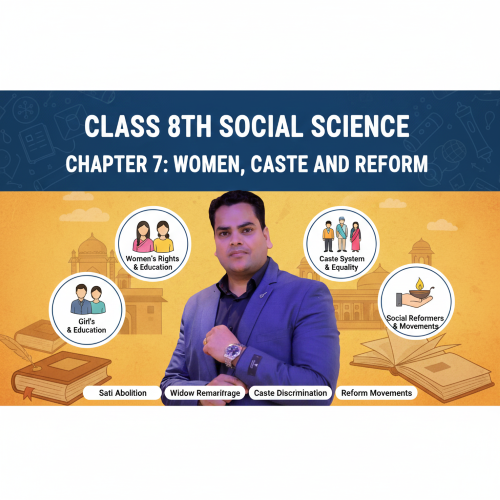
Chapter 7: Women,Caste and Reform
Women, Caste and Reform – Notes for CBSE Class 8 Social Science
Introduction to Caste and Reform
In the 19th and early 20th centuries, Indian society Caste and Reform faced deep inequalities related to women and caste. Women suffered from practices like sati, child marriage, and widowhood restrictions, while lower castes faced untouchability and discrimination. Social reformers worked hard for change, focusing on Caste and Reform. This chapter highlights how debates and movements led to progress in women’s rights and Caste and Reform.
Condition of Women in the 19th Century
Two hundred years ago, women’s lives were restricted. Upper-caste Hindu widows faced harsh rules: head shaved, plain white sarees, no remarriage. Many were forced into sati (burning on husband’s pyre). Child marriage was common, and girls had no education. Polygamy existed among some castes. Reformers saw these as unjust and pushed for Caste and Reform alongside women’s issues.
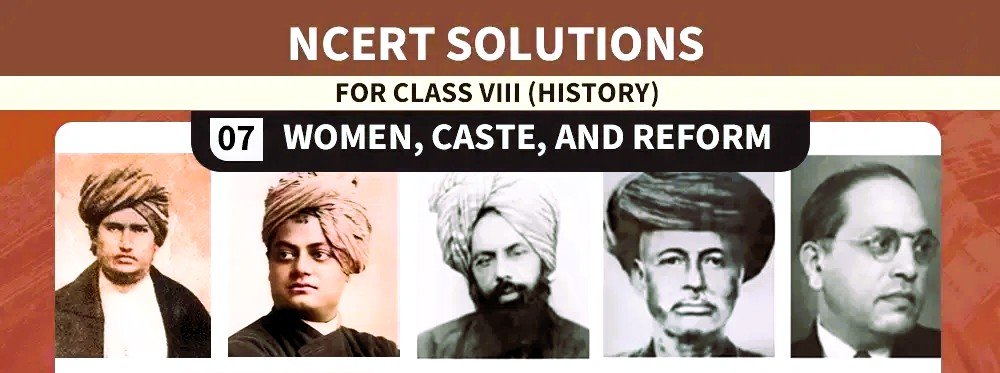
Raja Rammohun Roy, founder of Brahmo Samaj (1828), campaigned against sati. He used ancient texts to argue it wasn’t traditional. With support from reformers and British officials like William Bentinck, sati was banned in 1829. This was a major step in Caste and Reform linked to gender.
Widow Remarriage and Laws
Ishwarchandra Vidyasagar campaigned for widow remarriage using Hindu scriptures. In 1856, a law allowed it. Veerasalingam Pantulu in south India and Dayanand Saraswati (Arya Samaj) supported this. These efforts connected to broader Caste and Reform.
Girls’ Education and Women’s Voices
Reformers realized education was key. In the 19th century, few girls went to school due to fears of losing domestic skills or corruption. By the 1880s, schools opened in cities. Christian missionaries started schools for girls. Savitribai Phule (with Jyotirao Phule) opened schools for girls and lower castes in Maharashtra.
Begums of Bhopal promoted Muslim girls’ education. Women like Tarabai Shinde wrote “Stri Purush Tulna” (1882) criticizing gender differences. Pandita Ramabai criticized Hinduism’s oppression of women and started a widow home in Pune. Rokeya Sakhawat Hossain wrote against purdah. By the 20th century, women entered universities and professions. Education empowered women and supported Caste and Reform.
Caste System and Discrimination
Society was divided by caste: Brahmans and Kshatriyas (upper), Vaishyas (traders), Shudras (peasants/artisans). Lowest were “untouchables” (polluting jobs, no temple entry, separate wells). Lower castes faced daily humiliation. Reformers demanded equality through Caste and Reform.
Reformers Against Caste Inequality
Jyotirao Phule, from a “low” caste, founded Satyashodhak Samaj (1873) for caste equality. He opened schools for girls and non-Brahmans. In “Gulamgiri” (1873), he compared caste oppression to American slavery, arguing Aryans subjugated original inhabitants. Phule’s work was central to Caste and Reform.
In central India, Ghasidas founded Satnami movement for leatherworkers. In eastern Bengal, Haridas Thakur’s Matua sect worked among Chandala cultivators. Sri Narayana Guru (Kerala) fought caste rigidity for Ezhavas, consecrating temples open to all. His slogan: “One caste, one religion, one god for humankind.”
Prarthana Samaj and Paramhans Mandali in Bombay abolished caste taboos. In Madras, E.V. Ramaswamy Naicker (Periyar) started Self-Respect Movement, criticizing caste and gender oppression.
Dr. B.R. Ambedkar organized Dalits, led temple entry movements (e.g., Kalaram Temple, 1927), and burned Manusmriti. He fought for separate electorates but agreed to Poona Pact (1932) for reserved seats. Ambedkar’s efforts advanced Caste and Reform.
Non-Brahman and Other Movements
Non-Brahman movement challenged Brahman dominance. In south India, it linked to anti-caste struggles. Temple entry movements (e.g., Vaikom in Travancore) demanded access for lower castes. These were part of Caste and Reform.
Role of New Ideas and Opportunities
Printing press spread ideas through books, newspapers, and pamphlets. Poor people migrated to cities or plantations, escaping upper-caste oppression. New jobs in factories and government (merit-based) helped lower castes. Missionaries’ schools ignored caste segregation. These changes fueled Caste and Reform.
Opposition to Reforms
Conservatives opposed changes. Orthodox groups like Dharma Sabha defended sati and caste distinctions as scriptural. Upper castes resisted lower-caste education and entry. Despite opposition, reforms progressed through Caste and Reform.
Link to Nationalism
Social reforms strengthened nationalism. Leaders like Gandhi (Harijan campaign), Nehru, and Bose supported women’s and lower-caste rights. Unity against caste and gender prejudices helped the freedom struggle. The struggles for women and Caste and Reform were interconnected.
Conclusion
The 19th and 20th centuries saw tremendous changes through reformers’ efforts. Laws banned sati, allowed widow remarriage, promoted education, and challenged untouchability. Though caste and gender issues persist, these movements laid foundations for equality.
Download pdf notes and Sulutions of the Chapter:
Please Visit Readspot for Hindi Medium Study Material

You may also like
Chapter 6: Civilising the “Native”, Educating the Nation
Chapter 8: The Making of the National Movement