
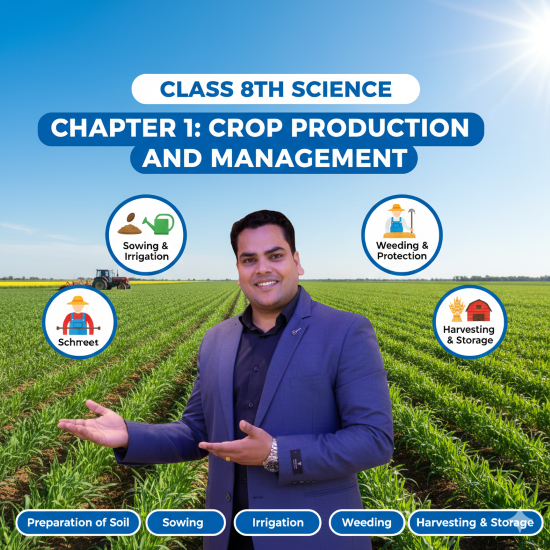
Chapter 1: Crop Production and Management
Chapter 1: Crop Production and Management
Introduction to Crop Production and Management
These notes of Crop Production and Management, cover the entire chapter systematically and are perfect for quick revision before exams. Write neatly, use diagrams (plough, hoe, sprinkler, drip system, seed drill) wherever possible to score better. Best of luck!
1. Introduction
- Food is obtained from both plants and animals.
- Major part of our food comes from crops (plant sources).
- Crops are plants of the same kind grown and cultivated at one place on a large scale.
- The branch of science that deals with growing crops and raising livestock is called Agriculture.
2. Types of Crops
Crops are mainly of two types based on seasons:
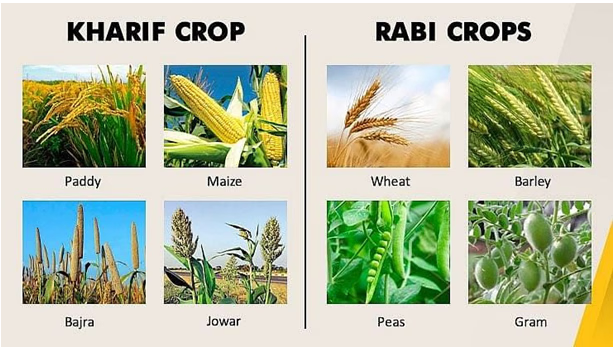
A. Kharif Crops
- Sown in the rainy season (June–July).
- Harvested at the end of monsoon (September–October).
- Examples: Paddy (rice), maize, soybean, groundnut, cotton, bajra, jowar.
B. Rabi Crops
- Sown in winter (October–November).
- Harvested in spring (March–April).
- Examples: Wheat, gram, pea, mustard, linseed, barley, potato.
3. Basic Agricultural Practices
To obtain good yield, farmers follow a series of steps called agricultural practices:
- Preparation of Soil
- Sowing
- Adding Manure and Fertilisers
- Irrigation
- Protection from Weeds
- Harvesting
- Storage
4. Preparation of Soil
- First and most important step.
- Soil is turned and loosened → process called tilling or ploughing.
- Loosened soil allows roots to penetrate deeply and breathe easily.
- Helps in better retention of water and mixing of nutrients.
Tools used:
- Traditional: Wooden plough (used with bullocks).
- Modern: Tractor-driven cultivator or hoe.
Steps: a) Ploughing b) Levelling (done with wooden plank/leveler) c) Adding manure before ploughing (optional).
5. Sowing
- Putting seeds in the soil at proper depth and distance.
- Good quality, healthy, clean seeds should be selected.
- Seeds can be sown by: a) Traditional method: Using seed drill pulled by bullocks. b) Modern method: Tractor-driven seed drill (sows seeds uniformly at proper depth and covers them with soil).
- Some seeds are first grown in nurseries and then transplanted (e.g., paddy, tomato, chilli).
Advantages of proper spacing:
- Plants get sufficient sunlight, water, and nutrients.
- Reduces competition among plants.
6. Adding Manures and Fertilisers
Soil supplies mineral nutrients to crops. Continuous growing depletes these nutrients.
A. Manure
- Prepared from decomposed plant and animal waste (cow dung, vegetable waste).
- Organic, improves soil structure, water-holding capacity.
- Less rich in nutrients compared to fertilisers.
B. Fertiliser
- Chemically prepared, rich in N, P, K (nitrogen, phosphorus, potassium).
- Examples: Urea (N), Superphosphate (P), NPK, Potash (K).
- Provide quick supply of nutrients but excess use harms soil fertility and environment.
Difference between manure and fertiliser:
| Manure | Fertiliser |
|---|---|
| Organic origin | Inorganic/chemical |
| Improves soil structure | Does not improve structure |
| Slow release of nutrients | Quick supply |
| No harmful side effects | Excess harms soil & water |
7. Irrigation
- Artificial supply of water to crops at regular intervals.
- Essential because water is needed for: → germination of seeds → absorption of nutrients → proper growth of plants.
Sources of irrigation:
- Wells, tubewells, ponds, lakes, rivers, dams, canals.
Modern methods of irrigation (save water): a) Sprinkler system – water sprinkled like rain, useful on uneven land. b) Drip system – water drips drop-by-drop near roots, best for fruit plants and gardens; minimum wastage.
Traditional methods: Moat, chain pump, dhekli, rahat (Persian wheel).
8. Protection from Weeds
- Weeds are unwanted plants that grow along with crops.
- Compete for water, nutrients, space, and light → reduce crop yield.
- Removal of weeds is called weeding.
Methods of weeding: a) Manual – by hand or khurpi. b) Tilling before sowing (uproots weeds). c) Weedicides – chemical sprays like 2,4-D. (Sprayed carefully, wearing protective clothes).
9. Harvesting
- Process of cutting and gathering mature crops from fields.
- Usually done manually with sickle or by machine (harvester).
- In India: → Kharif crops – September–October → Rabi crops – March–April
Post-harvesting steps: a) Threshing – separating grains from chaff (manually or thresher machine). b) Winnowing – blowing air to separate lighter chaff from heavier grains.
10. Storage
- Grains have moisture → if stored improperly, attacked by insects, rats, fungi.
- Steps before storage: → Sun-drying (reduces moisture). → Chemical treatment (optional).
Storage places:
- Traditional: Mud bins, gunny bags, thatched huts.
- Modern: Silos, cold storages, godowns.
- Grains stored in airtight containers with neem leaves or chemical preservatives at home.
11. Food from Animals (Animal Husbandry)
- Raising animals for milk, egg, meat, etc.
- Animals providing milk: Cow, buffalo, goat.
- Egg and meat: Poultry (hen, duck).
- Fish: Fisheries (inland and marine).
- Honey: Apiculture (beekeeping).
Key Terms to Remember
- Agriculture – Cultivation of crops and rearing of animals.
- Kharif crops – Rainy season crops.
- Rabi crops – Winter season crops.
- Ploughing – Turning and loosening soil.
- Manure – Organic substance from decomposed waste.
- Fertiliser – Inorganic nutrient-rich substance.
- Irrigation – Supplying water to crops.
- Weeds – Unwanted plants in crop fields.
- Weedicides – Chemicals that kill weeds.
- Harvesting – Cutting mature crop.
- Threshing – Separating grains from harvested crop.
- Animal husbandry – Rearing animals for food products.
Important Points for Exams
- Difference between Kharif and Rabi crops with examples.
- Advantages of manure over fertilisers.
- Why is soil preparation important?
- Difference between traditional and modern methods of sowing and irrigation.
- How are grains stored on large scale?
- Harmful effects of continuous use of fertilisers.
- Role of weeds and their removal methods.
Download pdf notes and Sulutions of the Chapter:
Please Visit Readspot for Hindi Medium Study Material

You may also like

Chapter 2: Microorganisms Friend and Foe
Chapter 3: Coal and Petroleum
