
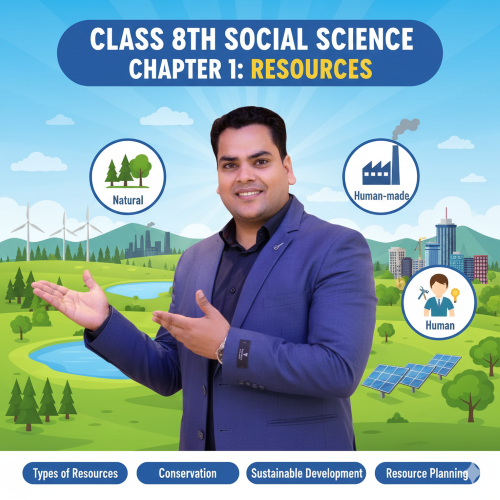
Chapter 1: Resources
Class 8 CBSE Social Science Chapter 1: Resources

Introduction to Resources:
These notes of Chapter 1: Resources are complete, point-wise and cover every line of the NCERT textbook. Use headings, bullet points, tables and coloured pens while writing in your notebook. Draw all diagrams neatly and label them properly to score full marks in exams. Happy learning!
1. Meaning of Resources
- Anything that can be used to satisfy a need is a resource.
- It must be technologically accessible, economically feasible and culturally acceptable.
- Example: Water, land, minerals, human beings, ideas, skills, etc.
Key characteristics of resources must have:
- Utility (usefulness)
- Value – Economic + Non-economic value)
- Availability in limited quantity)
2. Types of Resources
A. On the Basis of Origin
- Biotic Resources
- Obtained from biosphere and have life.
- Examples: Human beings, flora (plants), fauna (animals), fisheries, livestock, etc.
- Abiotic Resources
- Non-living things.
- Examples: Land, water, minerals, rocks, metals, air, sunlight).
B. On the Basis of Exhaustibility
- Renewable Resources (Flow Resources)
- Can be renewed or reproduced by physical, chemical or mechanical processes.
- Also called inexhaustible in some cases).
- Examples: Solar energy, wind energy, water, forests, wildlife.
- Some renewable resources can become non-renewable if over-exploited (e.g., groundwater, forests).
- Non-Renewable Resources
- Take millions of years to form.
- Once exhausted, cannot be renewed in short time.
- Also called exhaustible or stock resources.
- Examples: Coal, petroleum, natural gas, minerals (iron, copper, bauxite, gold, silver).
C. On the Basis of Ownership
- Individual Resources
- Owned privately by individuals.
- Examples: Plot of land, house, plantation, wells, pasture lands owned by a person.
- Community Resources
- Accessible to all members of the community.
- Examples: Public parks, picnic spots, playgrounds, grazing grounds, burial grounds, village ponds, public wells).
- National Resources
- All resources within the political boundaries and oceanic area (up to 12 nautical miles or 22.2 km from coast) belong to the nation.
- Examples: Roads, canals, railways, minerals, water resources, forests within country).
- International Resources
- Resources beyond 200 km of Exclusive Economic Zone (EEZ) in the ocean.
- No single country can use them without permission of international institutions.
- Examples: Oceanic waters beyond EEZ, manganese nodules in ocean beds).
D. On the Basis of Status of Development
- Potential Resources
- Found in a region but not utilised fully at present due to lack of technology or capital).
- Example: Rajasthan and Gujarat have huge potential for wind and solar energy but not fully developed yet).
- Uranium in Ladakh, high-speed winds in many areas).
- Developed Resources
- Resources whose quantity and quality are known and are being used with present technology).
- Example: Coal and petroleum deposits being used today).
- Stock Resources
- Materials in the environment that have the potential to satisfy human needs but humans do not have technology to use them.
- Example: Hydrogen and oxygen in water can be used as rich sources of energy but technology is not available).
- Reserves
- Subset of stock.
- Resources that can be used with present technology but their use has not been started.
- Kept for future use.
- Example: Water in dams, forest reserves).
3. Sustainable Development
- Development that meets the needs of the present generation without compromising the ability of future generations to meet their own needs.
- Brundtland Commission Report (1987) gave this concept.
- Goal: Balance between development and conservation of resources.
- Need: Resources are limited, population is increasing, lifestyle demands more resources).
Principles of Sustainable Development:
- Respect and care for all forms of life.
- Improve the quality of human life
- Conserve Earth’s vitality and diversity)
- Minimise the depletion of non-renewable resources)
- Keep development within Earth’s carrying capacity)
- Change personal attitude and practices toward environment)
4. Resource Conservation
- Using resources carefully and giving them time to get renewed. Methods:
- Reduce consumption
- Reuse materials
- Recycle waste (3Rs)
- Substitute non-renewable with renewable resources
- Use public transport instead of personal vehicles
- Switch off lights/fans when not needed
- Plant more trees
5. Human-Made Resources
- When natural substances are changed by human technology to add more value, they become human-made resources.
- Examples:
- Buildings, bridges, roads, machines, vehicles
- Technology, knowledge, skills, health, education
- Iron ore → steel → machines)
6. Human Resources
- People are the ultimate resource).
- Healthy, educated and skilled people develop resources as per requirements.
- Human resource development: Improving quality of people’s skills so that they can create more resources.
- Investment in education, health, training → increases human capital.
7. Distribution of Resources
- Resources are not evenly distributed on Earth.
- Some regions are rich in one resource but poor in others. Example:
- Jharkhand → rich in minerals, poor in infrastructure
- Rajasthan → rich in solar energy, scarce water
- Arunachal Pradesh → abundant water, lacks roads/railways
This unequal distribution leads to international trade.
Important Diagrams / Flow Charts to Draw
- Classification of Resources (tree diagram) – Origin → Biotic / Abiotic – Exhaustibility → Renewable / Non-renewable – Ownership → Individual / Community / National / International – Development → Potential / Developed / Stock / Reserve
- Difference between Potential and Developed Resources
- Difference between Stock and Reserve
- 3Rs – Reduce, Reuse, Recycle) with examples
Key Points for Quick Revision / Exam)
- set theory, topology)
- Define resource with three conditions ( utility, value, technology).
- Difference between biotic and abiotic, renewable and non-renewable.
- Why are human beings considered the most important resource?
- What is sustainable development? Why is it needed?
- Examples of potential resources in India.
- Meaning of stock and reserve with examples.
- How can we conserve resources at personal and community level?
- Role of technology in converting natural substances into resources.
Download pdf notes and Sulutions of the Chapter:
Please Visit Readspot for Hindi Medium Study Material
Tag:CBSE Class 8 Resources Notes PDF, Class 8 Geography Chapter 1 Resources, Class 8 Resources Notes, Class 8 SST Chapter 1 Resources PDF Free Download, Class 8 SST Resources Notes, Renewable and Non-Renewable Resources Class 8, Resources, Resources Class 8 NCERT Solutions, Resources Class 8 Question Answers

You may also like
Chapter 6: Civilising the “Native”, Educating the Nation
14 December, 2025
Chapter 7: Women,Caste and Reform
14 December, 2025

Chapter 8: The Making of the National Movement
14 December, 2025