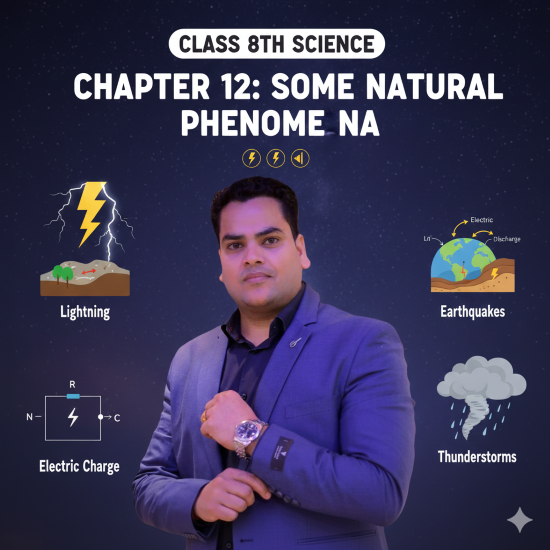
Chapter 12: Some Natural Phenomena
Chapter 12: Some Natural Phenomena
Introduction to Some Natural Phenomena
Some natural phenomena are beautiful and useful (rainbow, sunrise), while some are destructive (lightning, earthquake). This chapter mainly deals with two dangerous natural phenomena:
- Lightning and Thunder
- Earthquakes It also explains how we can protect ourselves from them.
1. Lightning
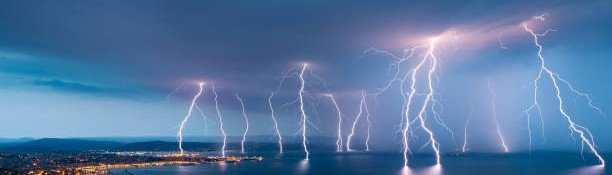
Lightning is a giant electric spark (electrical discharge) that occurs between clouds or between a cloud and the ground during a thunderstorm.
How clouds get charged (Charging by rubbing/interaction)
- When strong winds blow, air molecules rub against water droplets and ice crystals inside the cumulonimbus clouds.
- This rubbing causes transfer of electrons (like when we rub a plastic scale with hair).
- Lighter positive charges (+) move to the upper part of the cloud.
- Heavier negative charges (–) collect at the lower part of the cloud.
- The ground below the cloud becomes positively charged by induction.
Types of electric discharge
- Intra-cloud lightning: Discharge between +ve and –ve parts of the same cloud (most common).
- Inter-cloud lightning: Between two different clouds.
- Cloud-to-ground lightning: Most dangerous; negative charge from cloud jumps to positive ground → bright flash of lightning.
The air gets heated suddenly to about 30,000°C, expands explosively → produces thunder.
Why thunder is heard a few seconds after lightning is seen?
- Speed of light = 3 × 10⁸ m/s (almost instantaneous).
- Speed of sound = 340 m/s (much slower).
- So we first see the flash, then hear the sound after a few seconds.
2. Protection from Lightning
Lightning is attracted to tall objects and good conductors. Lightning conductor protects buildings.
Lightning Conductor
- A metallic rod (copper/aluminium) taller than the building.
- Fixed on the top of the building.
- A thick copper strip connects it to a metal plate buried deep in moist earth.
- When lightning strikes, the huge charge passes safely through the conductor to the earth without harming the building.
Safety measures during lightning (Do’s and Don’ts)
Safe places: Inside a house, bus, car (acts as Faraday cage). Unsafe places: Open fields, under tall trees, near electric poles, on tall structures.
During thunderstorm you should NOT:
- Stand under a tree
- Carry an umbrella with metal rod
- Talk on wired telephone
- Use electrical appliances
- Take bath under running water (water pipe can conduct electricity)
- Stand near metallic objects
You SHOULD:
- Squat low on the ground (lightning crouch)
- Stay inside a building or vehicle
- Use mobile phones (they are safe)
3. Earthquake
A sudden shaking or trembling of the earth lasting for a very short time is called an earthquake.
What causes an earthquake?
- Earth is made of four main layers: inner core, outer core, mantle, crust.
- Crust is broken into large pieces called tectonic plates.
- These plates are always moving very slowly (few cm per year).
- When two plates rub against each other or slide past each other along faults (cracks), huge stress builds up.
- When stress exceeds the strength of rocks, they break suddenly → energy is released as seismic waves → earthquake.
Focus and Epicentre
- The place inside the earth where the earthquake starts (rocks break) is called focus.
- The point on the earth’s surface exactly above the focus is called epicentre.
- Maximum destruction occurs at and around the epicentre.
Seismic waves (Seismographs record them)
- Primary (P) waves: Fastest, travel through solids and liquids.
- Secondary (S) waves: Slower, travel only through solids.
- Surface (L) waves: Slowest but most destructive.
Richter Scale (Measures magnitude)
- Measures the energy released by an earthquake.
- Logarithmic scale: Magnitude 5 is 10 times stronger than magnitude 4.
- Minor: < 5
- Damaging: 5–6.9
- Destructive: 7–7.9
- Very destructive: ≥ 8
Tsunami
- Earthquakes under the sea can displace huge amounts of water → giant sea waves called tsunami.
- Can travel at 800 km/h in deep ocean and reach heights of 15–30 m when they hit the coast.
4. Seismic Zones in India
India is divided into four seismic zones (Zone II to Zone V):
- Zone V (highest risk): North-east India, Kashmir, parts of Himachal, Uttarakhand, Bihar, Gujarat (Kutch).
- Delhi falls in Zone IV (high risk).
5. Protection against Earthquakes
Earthquakes cannot be predicted accurately, so we must be prepared.
What to do during an earthquake
If indoors:
- Take cover under a strong table (Drop, Cover, Hold on).
- Stay away from windows, mirrors, heavy furniture.
- Do not use elevators.
If outdoors:
- Move to an open area away from buildings, trees, electric poles.
- If in a vehicle, stop and stay inside.
If in a crowded place:
- Do not rush towards exits; take cover.
After the earthquake:
- Check for injuries, gas leaks, damaged wiring.
- Be ready for aftershocks.
How to make buildings earthquake-resistant
- Use flexible materials (wood, steel) instead of brittle ones (mud, concrete).
- Foundations deep and strong.
- Buildings on rollers or rubber pads to absorb shocks.
- In hilly areas: step-like construction, avoid weak soil.
6. Other Natural Phenomena (Briefly mentioned)
- Rainbows: Formed by dispersion, refraction and reflection of sunlight in raindrops.
- But chapter focuses mainly on lightning and earthquakes.
Key Points to Remember (Summary)
- Lightning is caused by accumulation of charges in clouds → electric discharge.
- Thunder is due to sudden expansion of air heated by lightning.
- Lightning conductor protects tall buildings.
- During lightning, avoid open places, trees, water, metallic objects.
- Earthquakes are caused by movement of tectonic plates along faults.
- Richter scale measures magnitude; seismographs record tremors.
- Tsunami can be caused by undersea earthquakes.
- India has zones II to V; Zone V is most vulnerable.
- Earthquake-resistant buildings and “Drop, Cover, Hold on” are best safety measures.
Important Terms
- Electrostatic force: Force between charged objects.
- Earthing: Transferring unwanted charges to the ground.
- Seismograph: Instrument to record seismic waves.
- Tectonic plates: Giant pieces of earth’s crust.
- Fault zones: Weak zones where earthquakes are more likely.
Download pdf notes and Sulutions of the Chapter:
Please Visit Readspot for Hindi Medium Study Material

You may also like

Chapter 1: Crop Production and Management

Chapter 2: Microorganisms Friend and Foe