
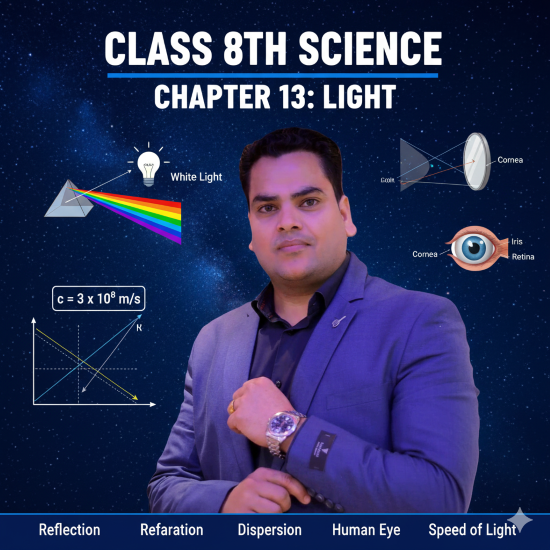
Chapter 13: Light
Breaf Notes of Chapter 16: Light
1. Introduction to Light
- Light is a form of energy that enables us to see the world around us.
- It travels in straight lines (rectilinear propagation of light).
- Light travels at a very high speed: 3 × 10⁸ m/s (300,000 km/s) in vacuum/air.
- Sources of light: → Natural: Sun, stars, fireflies (bioluminescence), lightning → Artificial: Bulb, tube light, candle, laser, LED
2. Types of Objects Based on Light
(i) Luminous objects: Emit their own light (e.g., Sun, bulb). (ii) Non-luminous objects: Do not emit light but can be seen when light falls on them (e.g., moon, table, book).
3. Reflection of Light
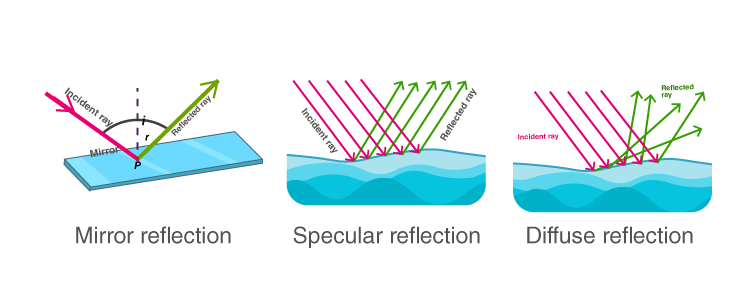
- When light falls on a surface and bounces back into the same medium, it is called reflection.
- Laws of Reflection (always hold true):
- Angle of incidence (i) = Angle of reflection (r) ∠i = ∠r
- The incident ray, reflected ray, and normal at the point of incidence all lie in the same plane.
4. Terms Related to Reflection
- Incident ray: Ray of light falling on the mirror.
- Reflected ray: Ray that bounces back.
- Normal: Perpendicular line drawn at the point of incidence.
- Point of incidence: Point where incident ray meets the mirror.
- Angle of incidence (∠i): Angle between incident ray and normal.
- Angle of reflection (∠r): Angle between reflected ray and normal.
5. Types of Reflection
- Regular reflection → Occurs on smooth, polished surfaces (plane mirror). → Forms clear and sharp image.
- Diffused/Irregular reflection → Occurs on rough surfaces (wall, paper). → Light scatters in all directions. → No clear image formed, but surface is visible. → Reason we can see most objects.
6. Plane Mirror – Characteristics of Image
- Image is virtual (cannot be obtained on screen).
- Image is erect.
- Image is laterally inverted (left appears right and vice versa).
- Image is of same size as object.
- Image distance = Object distance from mirror.
- Image is formed as far behind the mirror as the object is in front.
7. Multiple Images by Plane Mirrors
- When two mirrors are placed at an angle θ, number of images formed = (360°/θ) – 1 Example: → 90° → 3 images → 60° → 5 images → 120° → 2 images
8. Kaleidoscope
- Works on the principle of multiple reflections.
- Contains three plane mirrors inclined at 60° to each other.
- Produces beautiful symmetrical patterns.
9. Periscope
- Used in submarines and tanks to see above water/ground.
- Uses two plane mirrors placed parallel at 45° angle.
- Light reflects twice and allows viewing over obstacles.
10. Dispersion of Light
- Splitting of white light into its seven constituent colours (VIBGYOR) when it passes through a prism.
- Cause: Different colours travel at different speeds in a medium → bend by different amounts (refraction).
- Order of colours: Violet bends most, Red bends least.
11. Rainbow
- Natural phenomenon of dispersion.
- Formed when sunlight passes through tiny raindrops acting as prisms.
- Two types: Primary rainbow (brighter, red on top), Secondary rainbow (fainter, violet on top).
12. Human Eye – Structure and Functioning
- Natural optical instrument. Main parts and their functions:
- Cornea: Transparent front part; refracts light.
- Iris: Controls size of pupil (coloured part).
- Pupil: Hole that allows light to enter.
- Eye lens: Crystalline, convex lens; forms real, inverted image on retina.
- Ciliary muscles: Change curvature of lens for accommodation.
- Retina: Screen where image is formed; contains rods (dim light) and cones (colours & bright light).
- Optic nerve: Carries image signals to brain.
- Persistence of vision: Image remains on retina for 1/16th second → helps in watching movies.
13. How We See Objects
- Light from object → enters eye → refracted by cornea & lens → real, inverted image on retina → brain interprets as erect.
14. Care of Eyes
- Wash eyes with cold water.
- Read at proper distance (25–30 cm) and in sufficient light.
- Do not look at the sun directly.
- Eat foods rich in Vitamin A (carrot, amla, papaya, green leafy vegetables).
- Visit eye specialist if irritation persists.
15. Defects of Vision and Corrections
- Myopia (Near-sightedness)
- Can see near objects clearly, distant objects blurred.
- Cause: Eyeball elongated or lens too convex.
- Image formed in front of retina.
- Correction: Concave lens (diverging lens).
- Hypermetropia (Far-sightedness)
- Can see distant objects clearly, near objects blurred.
- Cause: Eyeball shortened or lens too flat.
- Image formed behind retina.
- Correction: Convex lens (converging lens).
- Presbyopia
- Old age problem; cannot see near and distant objects clearly.
- Due to weakening of ciliary muscles.
- Correction: Bifocal lenses (upper part concave, lower part convex).
- Cataract
- Lens becomes cloudy/opaque.
- Surgery: Replace natural lens with artificial lens.
16. Visually Impaired Persons – Braille System
- Developed by Louis Braille.
- Uses raised dots (6-dot cell) to represent letters/numbers.
- Blind people read by touching.
- Modern aids: Screen reading software, audiobooks, talking watches.
17. Important Points to Remember
- Light always travels in straight lines → proved by pinhole camera and shadows.
- Speed of light is highest in vacuum.
- We see the moon because it reflects sunlight.
- Sun appears reddish at sunrise/sunset due to scattering of light (blue light scatters more, red reaches us).
- Atmosphere scatters blue light → sky appears blue.
Key Diagrams to Practice
- Ray diagram showing laws of reflection.
- Image formation by plane mirror.
- Multiple images by two inclined mirrors.
- Dispersion through prism.
- Structure of human eye.
- Defects of vision (myopia, hypermetropia) with ray diagrams and correction.
Download pdf notes and Sulutions of the Chapter:

You may also like

Chapter 1: Crop Production and Management
26 November, 2025

Chapter 2: Microorganisms Friend and Foe
26 November, 2025
Chapter 3: Coal and Petroleum
26 November, 2025