Chapter 2: Natural Vegetation and Wildlife Resources
Chapter 2: Natural Vegetation and Wildlife Resources
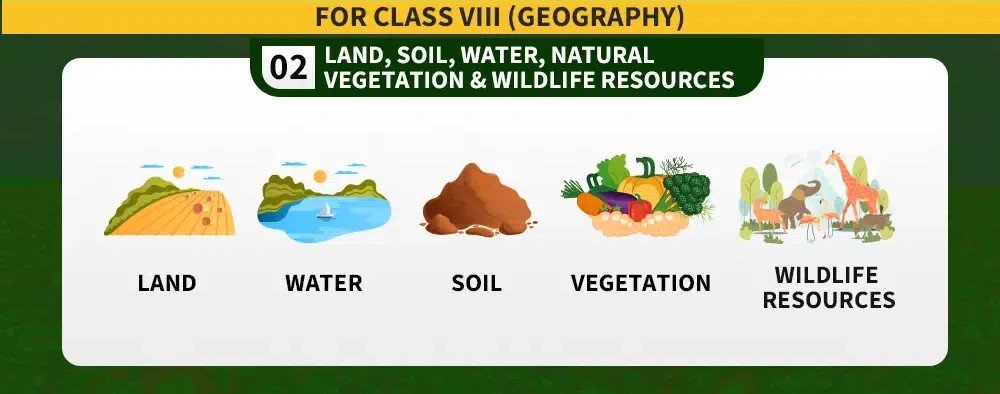
1. Introduction to Natural Vegetation and Wildlife Resources:
These notes of Chapter 2: Natural Vegetation and Wildlife Resources cover the entire chapter in a structured manner. Revise with maps and diagrams to score full marks in exams. All the best!
- Land, soil, water, natural vegetation and wildlife are the major natural resources of the Earth.
- These resources are unevenly distributed and are interdependent.
- Human beings use these resources for survival, agriculture, settlement, industry and transport.
- Overuse and misuse of resources lead to land degradation, water scarcity, deforestation and loss of biodiversity.
2. Land
- Land covers about 30 % of the Earth’s surface (the rest 70 % is water).
- 90 % of the world population lives on only 30 % land area.
Land Uses
- Forests
- Agriculture (cultivable land)
- Pastures and grazing land
- Human settlements, roads, industries
- Barren land (mountains, deserts)
Types of Land
- Private land: Owned by individuals.
- Community land: Used by local community (grazing, collecting firewood, etc.).
Factors Affecting Land Use
- Physical: Topography, soil type, climate, minerals.
- Human: Population density, technology, culture.
Problems of Land
- Land degradation, landslides, desertification, soil erosion.
- Causes: Deforestation, overgrazing, mining, over-irrigation, industrial waste.
Conservation of Land
- Afforestation, controlled grazing, shelter belts, checking over-irrigation, proper disposal of industrial waste, mulching, contour ploughing, terrace farming, strip cropping.
3. Soil
- The thin upper layer of the Earth’s crust made of loose rock material mixed with humus is called soil.
- It takes thousands of years to form even 1 cm of soil.
Factors of Soil Formation
- Parent rock
- Climate (temperature and rainfall)
- Relief (slope)
- Flora, fauna and micro-organisms
- Time
Soil Profile (Layers/Horizons)
- Topsoil (A-horizon): Rich in humus, dark, supports plants.
- Subsoil (B-horizon): Less humus, more minerals.
- Substratum (C-horizon): Weathered parent rock.
- Bedrock: Unweathered hard rock.
Degradation of Soil Causes:
- Deforestation → loss of topsoil.
- Overgrazing → removes vegetation cover.
- Overuse of chemical fertilisers.
- Faulty methods of farming.
Methods of Soil Conservation
- Contour ploughing
- Terrace farming (on slopes)
- Strip cropping
- Shelter belts (rows of trees to check wind erosion)
- Mulching
- Crop rotation and inter-cropping
- Rock dams
- Afforestation and reforestation
4. Water
- About 71 % of the Earth’s surface is covered with water, but 97 % is saline (oceans).
- Only 3 % is fresh water → out of which 2 % is frozen in glaciers and ice caps.
- Only 1 % of fresh water is available for human use (rivers, lakes, groundwater).
Problems Related to Water
- Water scarcity in many regions.
- Pollution of water bodies.
- Unequal distribution.
- Over-exploitation of groundwater.
Causes of Water Scarcity
- Increasing population and industries.
- Unequal distribution of rainfall.
- Overuse in agriculture.
- Pollution.
Conservation of Water
- Rainwater harvesting
- Drip irrigation and sprinkler irrigation
- Reusing and recycling water
- Afforestation (increases groundwater recharge)
- Building bawris, johads, check dams
- Treating industrial and sewage water before releasing
5. Natural Vegetation and Wildlife
- Natural vegetation and wildlife exist only in the narrow zone of contact between lithosphere, hydrosphere and atmosphere → called Biosphere.
- Plants that grow naturally without human help are called natural vegetation.
- Animals living in natural conditions are called wildlife.
Types of Natural Vegetation
- Forests
- Tropical Evergreen
- Tropical Deciduous
- Temperate Evergreen
- Temperate Deciduous
- Mediterranean
- Coniferous (Taiga)
- Grasslands
- Tropical (Savanna, Llanos)
- Temperate (Steppes, Prairies, Pampas)
- Shrubs and Thorny bushes (in deserts and semi-arid regions)
Distribution of Natural Vegetation Depends on:
- Climate (temperature, rainfall, sunlight
- Relief (altitude and slope)
- Soil type
Major Ecosystems/Biomes
- Tropical rainforests → Amazon basin, Congo basin, South-east Asia
- Grasslands → Africa (Savanna), North America (Prairies)
- Deserts → Sahara, Thar, Kalahari
- Tundra → Near poles, very less vegetation
- Taiga → Coniferous forests of Canada, Russia
Wildlife
- Found in forests, grasslands, deserts, water bodies.
- Examples: Elephant, tiger, lion, deer, monkey, one-horned rhinoceros (India), kangaroo (Australia), penguin (Antarctica).
Threats to Wildlife
- Deforestation and habitat loss
- Poaching and hunting
- Pollution
- Climate change
Conservation of Natural Vegetation and Wildlife
- National Parks, Wildlife Sanctuaries, Biosphere Reserves
- Project Tiger, Project Rhino, Project Elephant
- CITES (Convention on International Trade in Endangered Species)
- Banning hunting and trade of wildlife products
- Afforestation and reforestation
- Awareness programmes
6. Important Terms
- Land degradation: Decline in quality of land.
- Desertification: Expansion of desert due to human activities and climate change.
- Soil erosion: Removal of topsoil by wind or water.
- Contour barriers: Stones or grass placed along contours to stop runoff.
- Biosphere reserve: Large protected area for conserving biodiversity (e.g., Nilgiri, Sunderbans).
- Endangered species: Species at risk of extinction (e.g., tiger, rhino).
- Extinct species: No longer existing (e.g., dodo, passenger pigeon).
7. Key Points for Exams
- Percentage of land and water on Earth.
- Difference between private and community land.
- Methods of soil conservation with examples.
- Causes and conservation of water.
- Factors affecting natural vegetation.
- Difference between national park and biosphere reserve.
- Importance of forests and wildlife.
- Rainwater harvesting and its advantages.
Diagrams to Draw
- Layers of soil profile
- Terrace farming
- Shelter belts
- Rainwater harvesting structure
- Major biomes of the world (map)
Download pdf notes and Sulutions of the Chapter:
Please Visit Readspot for Hindi Medium Study Material
Tag:Class 8 Geography Chapter Land Soil Water, Class 8 Geography chapter-wise notes, Class 8 Social Science notes PDF download, Land Soil Water Natural Vegetation Wildlife Class 8 solutions, Land Soil Water Natural Vegetation Wildlife Notes, Natural Vegetation and Wildlife Resources, NCERT Geography Class 8 chapter 2 PDF

You may also like
Chapter 6: Civilising the “Native”, Educating the Nation

Chapter 7: Women,Caste and Reform