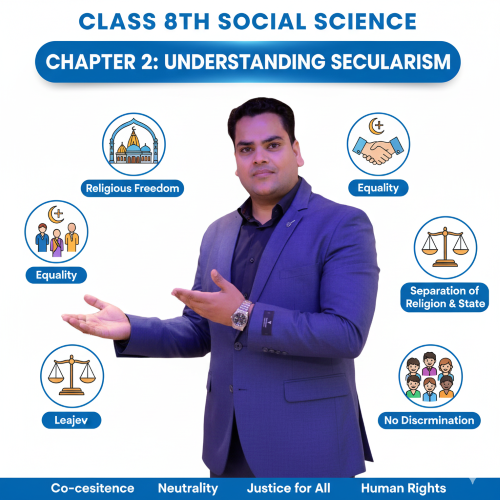
Chapter 2: Understanding Secularism
CBSE Class 8th Chapter 2: Understanding Secularism

Introduction to Secularism
History of Secularism has seen many cruel acts of discrimination, persecution, and torture based on religion. People have been forced to follow certain religions or faced violence for their beliefs. To protect citizens from such issues, countries adopt secularism. Secularism refers to the separation of religion from the State. In a country practicing secularism, the government does not promote any one religion as the official religion. India is a secular country where secularism ensures that all religions are treated equally.
The Indian Constitution declares India a secular state. Secularism is important because it protects the freedom of individuals to practice any religion they choose. Without secularism, one religious community might dominate others, leading to discrimination. Secularism prevents the tyranny of the majority and ensures equality.
Why is it Important to Separate Religion from the State?
It is crucial to separate religion from the State to uphold secularism. If the State supports one religion, it can lead to discrimination against others. For example, in some countries, minority communities face persecution because the State favors the majority religion. Acts of discrimination happen more easily when the State gives official recognition to one religion.
Secularism stops all forms of religious domination. The main reasons for separating religion from the State under secularism are:
- To prevent one religious community from dominating another.
- To ensure members within the same religion do not dominate each other (e.g., no caste-based discrimination).
- To protect the freedom of individuals to follow, interpret, or even exit their religion.
In India, secularism allows people to live by their religious beliefs without fear. The government cannot force anyone to follow a particular religion. This separation is the essence of secularism.
What is Indian Secularism?
Indian secularism is unique. Unlike some countries where there is strict separation (like the USA, where the State cannot interfere in religion at all), Indian secularism follows a strategy of distance but also intervention when needed.
The Indian State practices secularism by:
- Not enforcing any particular religion.
- Not taking away religious freedom.
- Maintaining principled distance from all religions.
To achieve secularism, the Indian Constitution ensures:
- One religious community does not dominate another.
- Within a community, some members do not dominate others.
- The State remains neutral and supports equality.
Examples of Indian secularism in action:
- Government schools do not celebrate religious festivals to avoid favoring one religion.
- Public holidays include festivals from different religions like Diwali, Eid, Christmas, and Guru Nanak Jayanti, showing respect for all under secularism.
- The government provides subsidies for religious pilgrimages or maintains places of worship without favoring one.
How Does the Indian State Practice Secularism?
Indian secularism uses three main strategies:
- Strategy of Distance (Non-interference): The State keeps away from religious matters most of the time. For example, it does not dictate how people should pray or celebrate festivals.
- Strategy of Non-interference with Support: The State supports religions equally. It wears tilak or hijab symbols in official photos sometimes to show neutrality, or funds community kitchens in religious places.
- Strategy of Intervention: This is a key feature of Indian secularism. The State can intervene in religious affairs to prevent discrimination or violation of Fundamental Rights. For example:
- Banning untouchability: The Constitution abolished untouchability, which was a religious practice discriminating against lower castes within Hinduism.
- Reforming laws: The State intervened to ban practices like triple talaq in some cases or ensure equality in inheritance laws across religions.
In Indian secularism, coercion (forcing someone) in religion is not allowed. People have the freedom to interpret their religion as they wish.
Difference Between Indian Secularism and Other Forms
In the USA, secularism means a strict wall between State and religion – no interference at all. But in India, secularism allows the State to intervene positively for equality. This makes Indian secularism more flexible and suited to India’s diverse society.
Indian secularism protects minorities from majority domination and also subgroups within religions. For instance, it ensures women or lower castes are not oppressed in the name of religion.
Objectives of a Secular State
A secular state like India aims for:
- Equality among religions.
- Freedom of religion as a Fundamental Right.
- No official religion.
- Protection from religious tyranny.
Secularism in India was strengthened by adding the word “secular” to the Preamble through the 42nd Amendment.
Examples Proving India is Secular
- No compulsory religious education in government schools.
- Equal treatment in laws (though personal laws vary, reforms ensure justice).
- Protection of minority rights, like special provisions for linguistic or religious minorities.
Download pdf notes and Sulutions of the Chapter:
Please Visit Readspot for Hindi Medium Study Material

You may also like

Chapter 6: Civilising the “Native”, Educating the Nation

Chapter 7: Women,Caste and Reform