Chapter 3: Parliament and the Making of Laws
CBSE Class 8th Chapter 3: Parliament and the Making of Laws
Why Do We Need a Parliament ?
In a democracy, people participate in decision-making and give consent to the government through elections. Parliament is the key institution where elected representatives discuss national issues and make decisions. Parliament enables citizens to control the government and express their views. Without Parliament, there would be no way for people to approve or check government actions. Parliament is the supreme law-making body in India and represents the will of the people. It is essential because Parliament ensures government by consent and participation. Parliament is a symbol of Indian democracy.
People and Parliament
Citizens elect Members of Parliament (MPs) through universal adult franchise. Every adult above 18 years has the right to vote, regardless of religion, caste, or gender. People elect representatives to Parliament, who then form the government. The ruling party or coalition selects the Prime Minister and ministers. Parliament consists of all these elected representatives who voice people’s concerns.
Structure of Parliament
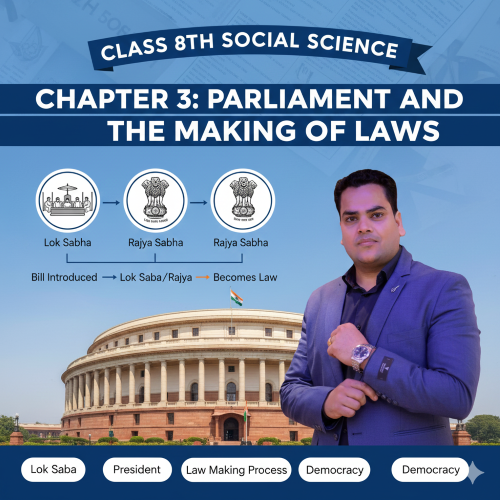
The Indian Parliament is bicameral, meaning it has two houses: Lok Sabha and Rajya Sabha, plus the President.
- Lok Sabha (House of the People): Directly elected by people every 5 years. Maximum 543 elected members + 2 nominated. It is more powerful in money matters.
- Rajya Sabha (Council of States): Indirectly elected by state assemblies, permanent house (1/3 members retire every 2 years). Maximum 250 members. It represents states. The President is part of Parliament and gives assent to bills. Parliament sessions involve both houses working together.
Role and Functions of Parliament
Parliament has several important functions:
- To select the executive: Lok Sabha chooses the government. The Prime Minister is the leader of the majority party in Lok Sabha.
- To control, guide, and inform the government: MPs ask questions during Question Hour. Parliament debates policies and holds the government accountable.
- Law-making: The most important function of Parliament is to make laws for the nation. Parliament approves the budget and controls finances. The opposition in Parliament criticizes the government and highlights drawbacks.
Who are the People in Parliament?
Parliament has representatives from diverse backgrounds: rural, urban, different castes, religions, and regions. There is increasing participation from Dalits, backward classes, minorities, and women. Seats are reserved for SCs and STs in Parliament. Many MPs belong to national or regional parties. Coalition governments are common when no single party gets a majority in Parliament.
How Laws are Made in Parliament
The process of making laws shows the importance of Parliament. A bill (proposed law) can start in either house (except money bills, which start in Lok Sabha). Steps:
- Introduction of the bill in Parliament.
- First reading: Title and discussion.
- Second reading: Detailed debate and committee review.
- Third reading: Voting. If passed in one house, it goes to the other. If differences, a joint sitting may be called. Finally, the President gives assent, and it becomes law. Example: The Domestic Violence Act, 2005, started due to demands from women groups. It was debated in Parliament and passed to protect women.
Parliament can make laws on various issues like education, health, and security. Sometimes laws are unpopular but necessary. Parliament ensures laws reflect people’s needs through discussions.
Importance of Parliament in Democracy
Parliament is central to democracy because it represents people, makes laws, and checks the executive. Through Parliament, citizens influence decisions indirectly. Parliament promotes equality by including diverse voices. Without Parliament, the government could act without accountability.
Important Questions for Parliament and the Making of Laws
Very Short Answer Type Questions (1-2 marks)
- What is Parliament?
- Why do we need a Parliament in a democracy?
- Name the two Houses of the Indian Parliament.
- Which House of Parliament is more powerful in financial matters?
- Who is the head of the government in India?
- What is universal adult franchise?
- How is the Prime Minister chosen?
- What is a bill?
- Where do money bills originate?
- Who gives final assent to a bill to make it a law?
Short Answer Type Questions (3 marks)
- Explain the term ‘bicameral legislature’. Why does India have two Houses of Parliament?
- Differentiate between Lok Sabha and Rajya Sabha (any three points).
- Describe the role of the opposition in Parliament.
- What is Question Hour? Why is it important?
- Mention any three main functions of Parliament.
- How does Parliament control the executive? Give examples.
- Why is Parliament called the supreme law-making body?
- What happens if there is a disagreement between Lok Sabha and Rajya Sabha on a bill?
Long Answer Type Questions (5 marks)
- Describe the composition of Lok Sabha and Rajya Sabha.
- Explain the law-making process in Parliament step by step.
- “Parliament is the mirror of the nation.” Explain this statement with reference to representation of diverse groups.
- Discuss the importance of Parliament in a democratic country like India.
- How does Parliament ensure that the government works according to the wishes of the people? Explain with examples.
- Describe the role of the President in the functioning of Parliament.
- Explain how a bill becomes an Act. Take the example of the Protection of Women from Domestic Violence Act, 2005.
- Why is the Lok Sabha considered more powerful than the Rajya Sabha? Give reasons.
Assertion-Reason Type Questions
- Assertion (A): Parliament is essential for democracy. Reason (R): It enables citizens’ participation in decision-making through elected representatives. (Options: Both A and R are true and R is the correct explanation of A / Both true but R not explanation / A true R false / etc.)
- Assertion (A): Money bills can only be introduced in Lok Sabha. Reason (R): Lok Sabha is directly elected by the people.
Case-Based/Source-Based Questions
Source: In 2005, women’s groups demanded a law against domestic violence. After discussions and debates in Parliament, the Protection of Women from Domestic Violence Bill was passed and became an Act in 2006.
Questions: a) Why was there a need for public debate before making this law? b) Which function of Parliament is highlighted here? c) How does this show Parliament’s responsiveness to people’s issues?
Download pdf notes and Sulutions of the Chapter:
Please Visit Readspot for Hindi Medium Study Material

You may also like
Chapter 6: Civilising the “Native”, Educating the Nation

Chapter 7: Women,Caste and Reform