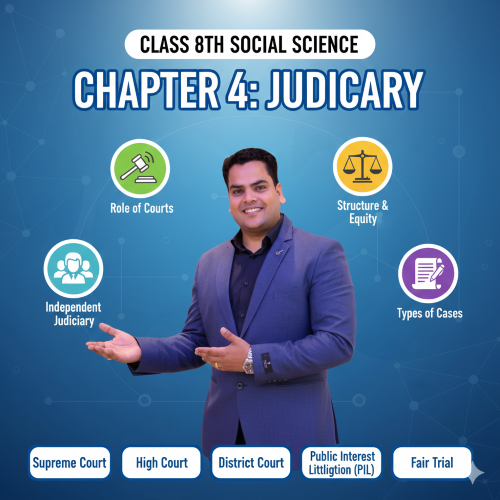
Chapter 4: Judiciary
(Class 8th CBSE Social Science Chapter 4: Judiciary

Introductiob to Judiciary:
The Judiciary is one of the three main pillars of democracy along with the Legislature and the Executive. The Judiciary is the system of courts that interprets and applies the law in the name of the state. The Judiciary protects the Constitution and the rights of citizens. In India, the Judiciary plays a very important role in keeping a balance of power between the Centre and the States and between different organs of the government.
Meaning and Need of Judiciary
Every country needs an independent Judiciary because disputes are part of daily life. People may have disputes with neighbours, family members, shopkeepers, employers, etc. The Judiciary settles these disputes in a fair manner. Without an independent Judiciary, the powerful people or the government itself could misuse the law. Therefore, the Judiciary acts as the guardian of the Fundamental Rights and the Constitution.
Structure of Judiciary in India
India has an integrated and single Judiciary. This means there is one single chain of courts from the lower level to the highest level for the whole country. The Judiciary in India is divided into several levels:
- Subordinate Courts (District Level and Below)
- Tehsil-level courts, District courts, Family courts, Consumer courts, etc.
- These courts handle most criminal and civil cases.
- High Courts
- Every state or group of states has a High Court.
- At present there are 25 High Courts in India.
- The High Court is the highest court at the state level and supervises all subordinate courts in the state.
- Supreme Court
- The Supreme Court is the highest court of the country and sits in New Delhi.
- It is the apex (topmost) level of the Indian Judiciary.
Because of this single integrated system, the Judiciary is also called the “single integrated judicial system”.
Independence of Judiciary
The Judiciary must be independent so that it can give justice without any pressure. In India, many steps are taken to keep the Judiciary independent:
- Judges are appointed (not elected) through a proper process.
- Judges of the Supreme Court and High Courts have security of tenure – they can only be removed by a very difficult process of impeachment.
- Salaries of judges are paid from the Consolidated Fund of India and cannot be reduced easily.
- The Judiciary has the power to punish anyone for contempt of court if someone tries to influence its decisions.
These steps keep the Judiciary free from the control of the Legislature and the Executive.
Functions/Powers of Judiciary
The Judiciary performs many important functions:
- Dispute Resolution The main work of the Judiciary is to settle disputes between individuals, between individuals and the government, and between state governments and the central government.
- Judicial Review The Judiciary has the power to check whether a law made by Parliament or state legislatures is according to the Constitution or not. If any law violates the Constitution, the Judiciary can declare it unconstitutional and void.
- Upholding the Law and Enforcing Fundamental Rights If anyone’s Fundamental Rights are violated, the person can directly approach the Supreme Court or High Court. The Judiciary protects our rights through writs.
- Guardian of the Constitution The Supreme Court is called the guardian of the Constitution because only the Judiciary can interpret the Constitution finally.
- Advisory Function The President can ask the Supreme Court for its opinion on important legal questions.
Different Branches of the Legal System
India has two main branches of law that the Judiciary deals with:
- Civil Law Deals with disputes related to property, marriage, contracts, money recovery, etc. Example: Dispute between landlord and tenant.
- Criminal Law Deals with crimes like theft, murder, cheating, etc. The state (government) files the case on behalf of the victim because crime is considered against society.
Public Interest Litigation (PIL)
Any citizen or organisation can file a case in the High Court or Supreme Court in the interest of the public, even if they are not personally affected. This is called Public Interest Litigation (PIL). Because of PIL, the Judiciary has been able to solve many social problems such as child labour, pollution, bonded labour, etc.
Access to Justice
The Judiciary tries to make justice reachable to everyone. Some steps are:
- Lok Adalats: These are “people’s courts” where cases are settled quickly and without much cost.
- Legal Aid: Poor people get free legal help from the government.
- Fast-track courts and mobile courts have also been started.
Even then, there are problems like huge backlog of cases (more than 4 crore cases pending), high cost of lawyers, and long time taken in deciding cases. The Judiciary is trying to solve these issues through computerisation (e-Courts) and Alternative Dispute Resolution methods.
Key Terms to Remember
- Judiciary: The system of courts that interprets and guards the law.
- Integrated Judiciary: One single system of courts for the whole country.
- Judicial Review: Power of courts to examine the constitutionality of laws.
- PIL: Public Interest Litigation – anyone can file case for public good.
- Writs: Orders issued by Supreme Court and High Courts to protect Fundamental Rights (Habeas Corpus, Mandamus, Prohibition, Certiorari, Quo Warranto).
- Original Jurisdiction: Cases that start directly in the Supreme Court (e.g., disputes between Centre and States).
- Appellate Jurisdiction: Hearing appeals from lower courts.
- Acquit: To declare the accused not guilty.
- Compensation: Money awarded to the victim.
Important Articles Related to Judiciary
- Article 124–147: Supreme Court
- Article 214–231: High Courts
- Article 32: Right to Constitutional Remedies (Dr. Ambedkar called it the “heart and soul” of the Constitution)
- Article 13: Laws inconsistent with Fundamental Rights are void
Role of Judiciary in Democracy
The Judiciary keeps a check on the Legislature and Executive so that they do not become too powerful. Through landmark judgments like Kesavananda Bharati case (1973), the Judiciary established the “Basic Structure Doctrine” – some parts of the Constitution cannot be changed even by Parliament. This shows how powerful and important the Judiciary is in protecting democracy.
In short, the Judiciary is the final interpreter of the Constitution, protector of Fundamental Rights, and the institution that gives justice to common people. An independent and strong Judiciary is the backbone of Indian democracy.
Download pdf notes and Sulutions of the Chapter:
Please Visit Readspot for Hindi Medium Study Material
Tag:CBSE Class 8 Judiciary notes PDF, Class 8 Civics Judiciary notes, Class 8 Social Science Judiciary, Class 8 Social Science Judiciary notes in simple language, Class 8 SST Civics Judiciary notes, Judiciary, Judiciary Class 8 important questions, Judiciary Class 8 NCERT solutions, Judiciary Class 8 question answers

You may also like

Chapter 6: Civilising the “Native”, Educating the Nation

Chapter 7: Women,Caste and Reform