
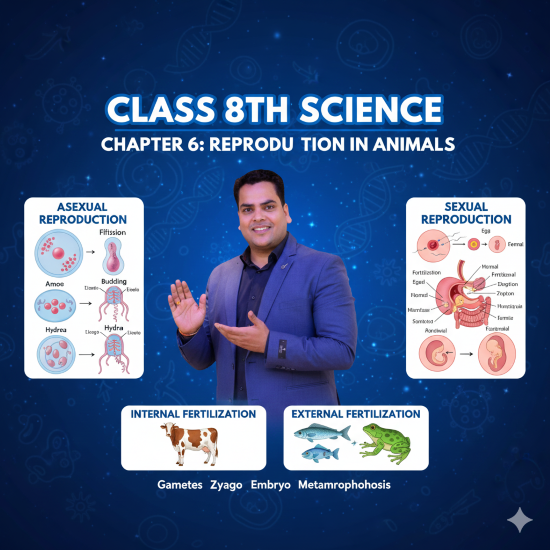
Chapter 6: Reproduction in Animals
Chapter 6: Reproduction in Animals
1. Introduction to Reproduction in Animals
These notes of Reproduction in Animals , cover the entire chapter as per latest CBSE Class 8 NCERT textbook (2024-25). Revise diagrams and tables thoroughly for neat answers and good marks!
- Reproduction is the biological process by which living organisms produce new individuals (offspring) of their own kind.
- It ensures the continuity of species.
- Two main modes of reproduction: → Asexual reproduction → Sexual reproduction
2. Asexual Reproduction
- Only one parent is involved.
- Offspring are genetically identical to the parent (clones).
- Common methods in animals:
| Method | Example | Description |
|---|---|---|
| Binary Fission | Amoeba, Paramecium | Parent cell divides into two equal daughter cells. |
| Budding | Hydra, Yeast A small outgrowth (bud) develops on parent body and detaches to form new individual. | |
| Fragmentation | Planaria (flatworm) Body breaks into pieces; each piece regenerates into a new organism. |
- Advantages: Fast, no need to find mate, large number of offspring.
- Disadvantages: No genetic variation → less adaptability.
3. Sexual Reproduction
- Involves two parents (male and female).
- Offspring show genetic variation → better survival chances.
- Involves special reproductive cells called gametes. → Male gamete = Sperm → Female gamete = Ovum (egg)
4. Male Reproductive System (in humans and mammals)
- Testes (pair) → produce sperms and male hormone testosterone.
- Scrotum → sac that keeps testes outside body (2–3 °C lower temperature needed for sperm production).
- Sperm ducts (vas deferens) → carry sperms.
- Accessory glands (prostate, seminal vesicles) → secrete seminal fluid → forms semen.
- Penis → deposits semen into female reproductive tract.
5. Female Reproductive System (in humans and mammals)
- Ovaries (pair) → produce ova (eggs) and female hormones (estrogen, progesterone).
- Oviducts (Fallopian tubes) → site of fertilisation.
- Uterus (womb) → place where embryo develops.
- Vagina → birth canal; receives penis during mating.
6. Fertilisation
- Fusion of male gamete (sperm) and female gamete (ovum) → zygote.
- Two types: (i) External fertilisation → Occurs outside the female body (in water). → Seen in frog, fish, starfish. → Large number of eggs and sperms released to increase chances of meeting. (ii) Internal fertilisation → Occurs inside female body. → Seen in humans, cows, dogs, birds, reptiles. → Fewer eggs produced because chances of fertilisation are higher.
7. Development of Embryo
- After fertilisation, zygote divides repeatedly → embryo.
- Two patterns:
| Type | Examples | Description |
|---|---|---|
| Oviparous | Hen, Frog, Butterfly, Fish | Embryo develops inside egg laid outside mother’s body. Hatching occurs after some time. |
| Viviparous | Human, Cow, Dog, Cat, Lion | Embryo develops inside mother’s uterus. Young one born alive after gestation period. |
| Ovoviviparous | Some sharks, lizards | Eggs develop and hatch inside mother’s body but no placenta; young one born alive. |
8. Special Structures in Some Animals
- Placenta (in viviparous mammals): → Connects embryo with mother’s blood through umbilical cord. → Supplies oxygen, nutrients; removes wastes.
- Metamorphosis: → Drastic change in body form during development. → Frog: Egg → Tadpole (gills, tail) → Adult frog (lungs, legs). → Butterfly: Egg → Larva (caterpillar) → Pupa (chrysalis) → Adult butterfly.
9. Cloning – Dolly the Sheep (1996)
- First mammal cloned from an adult cell (udder cell of sheep).
- Process:
- Nucleus removed from an egg cell.
- Nucleus from adult udder cell inserted into enucleated egg.
- Egg implanted into surrogate mother → Dolly born.
- Dolly was genetically identical to the sheep that donated the udder cell.
- Significance: Showed that specialised cells can be reprogrammed.
10. In Vitro Fertilisation (IVF) – Test-tube Baby
- Fertilisation done outside body in laboratory.
- Used when natural fertilisation fails (blocked oviducts, low sperm count).
- First test-tube baby: Louise Brown (1978, England).
11. Important Terms
- Zygote → Fertilised egg.
- Embryo → Early stage after zygote (up to 8 weeks in humans).
- Foetus → After 8 weeks till birth.
- Gestation period → Duration of pregnancy (≈9 months in humans, 22 months in elephant, 1 month in rabbit).
- Hermaphrodite → Animal having both male and female reproductive organs (e.g., earthworm, leech). Still needs another individual for sexual reproduction.
12. Quick Comparison Table
| Feature | Asexual Reproduction | Sexual Reproduction |
|---|---|---|
| Parents | One | Two |
| Gametes | Not formed | Formed |
| Offspring variation | No (identical) | Yes |
| Speed | Fast | Slower |
| Examples | Hydra, Amoeba | Humans, Dog, Hen, Frog |
13. Important Diagrams to Practise
- Male reproductive system of humans
- Female reproductive system of humans
- Life cycle of frog (metamorphosis)
- Life cycle of butterfly
- Binary fission in Amoeba
- Budding in Hydra
Key Points for Exams
- Animals showing external fertilisation are mostly aquatic.
- Viviparous animals give birth to young ones; oviparous lay eggs.
- Human sperm has tail for swimming; ovum is non-motile.
- Testosterone causes secondary sexual characters in boys (beard, voice change).
- Estrogen and progesterone cause secondary sexual characters in girls.
- Cloning produces genetically identical individuals.
Download pdf notes and Sulutions of the Chapter:
Please Visit Readspot for Hindi Medium Study Material

You may also like

Chapter 1: Crop Production and Management
26 November, 2025

Chapter 2: Microorganisms Friend and Foe
26 November, 2025

Chapter 3: Coal and Petroleum
26 November, 2025