
Chapter 6: Squares and Square Roots
Class 8 Mathematics Chapter 6: Squares and Square Roots
These notes on Squares and Square Roots cover the entire NCERT Chapter 6 for Class 8. Focus on long division method and properties of squares for board exams. Practice textbook exercises 6.3 and 6.4 thoroughly.
1. Introduction to Squares: Squares and Square Roots
- The square of a number is the product obtained when the number is multiplied by itself.
- Example: 5 × 5 = 25 → 25 is the square of 5 (written as 5² = 25) (-7) × (-7) = 49 → 49 is the square of -7 (negative × negative = positive)
- Perfect square: A number that is the square of an integer is called a perfect square. Examples: 1, 4, 9, 16, 25, 36, 49, 64, 81, 100, …
2. Properties of Perfect Squares
- A number ending with 2, 3, 7 or 8 can never be a perfect square.
- Possible last digits of perfect squares: 0, 1, 4, 5, 6, 9
- If a number ends with an odd number of zeros, it is not a perfect square.
- Example: 120, 1500 are not perfect squares.
- Square of an even number is always even; square of an odd number is always odd.
- Sum of first n odd numbers = n² Example: 1+3+5+7 = 16 = 4²
- There are 2n non-perfect square numbers between n² and (n+1)².
- Example: Between 8² = 64 and 9² = 81 → 65, 66, 67, 68, 69, 70, 71, 72, 73, 74, 75, 76, 77, 78, 79, 80 → 16 numbers (2×8).
3. Methods to Find Square of a Number
A. Column Method (Traditional)
Example: Find 43² 43 × 43 Step 1: Write vertically 43 × 43 ——— Step 2: 3 × 43 = 129 → write 9, carry 12 Step 3: 40 × 43 = 1720 + carry 12 = 1732 Step 4: Add → 1849 So, 43² = 1849
B. Algebraic Identities (Fast Method)
- (a + b)² = a² + 2ab + b²
- (a – b)² = a² – 2ab + b²
- Special cases: (i) Numbers ending with 5 → (a5)² = a(a+1) hundred + 25 Example: 35² = 3 × 4 hundred + 25 = 1225 (ii) (50 + x)² = 2500 + 100x + x² (iii) (100 + x)² = 10000 + 200x + x²
C. Using Diagonal Method / Vedic Maths (for fun, not in syllabus but helpful)
Not mandatory for CBSE, but quick for 2-digit numbers.
4. Square Roots (√)
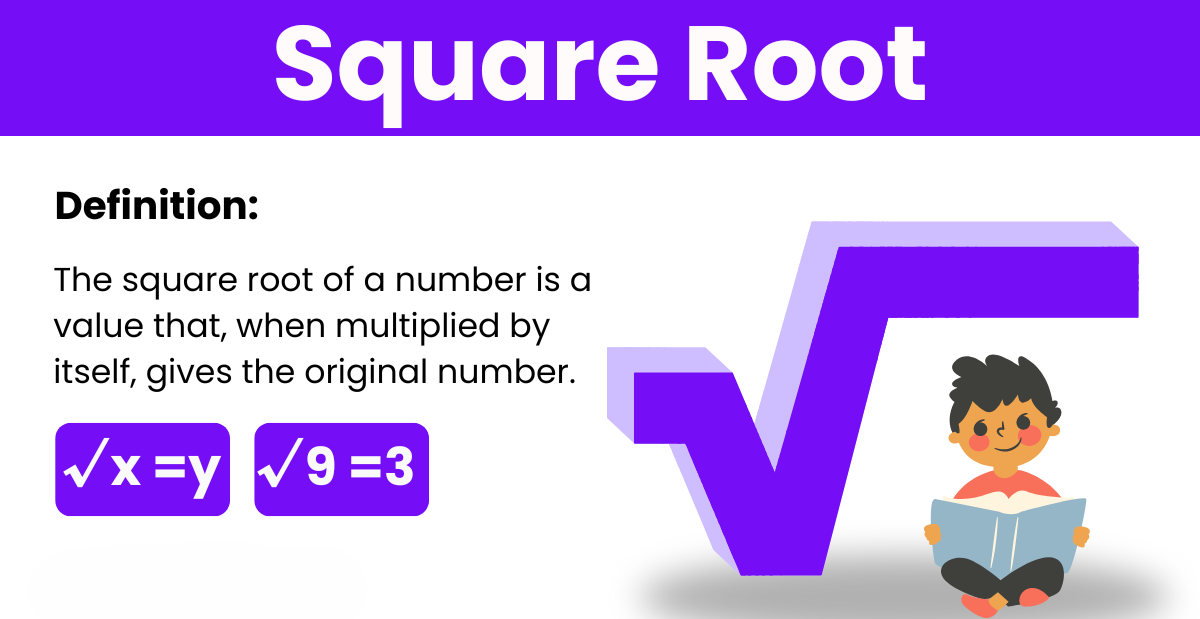
- The square root of a number x is a number which when multiplied by itself gives x.
- Symbol: √ (radical sign)
- √25 = 5 (principal/non-negative root)
- Note: √ is defined only for non-negative numbers in real numbers.
- Perfect square → exact integer square root Non-perfect square → irrational square root (e.g., √2, √3)
5. Methods to Find Square Root
Method 1: Prime Factorisation Method
Steps:
- Resolve the number into prime factors.
- Make pairs of identical factors.
- Take one factor from each pair and multiply.
- The product is the square root.
Example 1: √144 144 = 2×2×2×2×3×3 = (2² × 2² × 3²) √144 = 2 × 2 × 3 = 12
Example 2: √2025 2025 = 3×3×3×3×5×5 = 3² × 3² × 5² √2025 = 3 × 3 × 5 = 45
Method 2: Long Division Method (Most Important for exams)
Used for both perfect and non-perfect squares.
Steps for Long Division Method Example: Find √35721
- Pair digits from right → 35721 → 3 | 57 | 21
- Find largest number whose square ≤ 3 → 1² = 1 Subtract → 3-1 = 2
- Bring down next pair (57) → 257
- Double the quotient (1×2=2), write as divisor base → 2_ Find digit x such that (20 + x) × x ≤ 257 → x = 8 28 × 8 = 224 Subtract → 257-224 = 33
- Bring down next pair (21) → 3321
- Double current quotient (18×2=36) → 36_ Find digit y such that (360 + y) × y ≤ 3321 → y = 9 369 × 9 = 3321 Subtract → 0
- Quotient = 189 → √35721 = 189
For Non-Perfect Squares Example: √20 Pairs → 20 → 2 | 00 (add decimal and zeros) → Quotient comes 4.4… (terminates only if perfect square, else continues)
To find approximate value up to 2 decimal places Continue division till 3 decimal places and round off.
6. Finding Square Root of Decimals
Method:
- Make the number of decimal places even by adding zero if needed.
- Put pairs including before decimal.
- Proceed as usual.
Example: √0.000729 0.000729 → move decimal 6 places right → 729 √729 = 27 → move decimal 3 places left → 0.027
7. Square Root of Fractions
√(a/b) = √a / √b (provided a and b are perfect squares)
Example: √(256/289) = 16/17
8. Pythagorean Triplets
A triplet (a, b, c) where a² + b² = c² Common triplets:
- 3, 4, 5 → 9 + 16 = 25
- 5, 12, 13
- 7, 24, 25
- 8, 15, 17
- 9, 40, 41
- 20, 21, 29
General form: (m²-n², 2mn, m²+n²) where m > n
9. Some Important Squares (1 to 30) – Memorize
1² = 1 2² = 4 3² = 9 4² = 16 5² = 25 6² = 36 7² = 49 8² = 64 9² = 81 10² = 100 11² = 121 12² = 144 13² = 169 14² = 196 15² = 225 16² = 256 17² = 289 18² = 324 19² = 361 20² = 400 21² = 441 22² = 484 23² = 529 24² = 576 25² = 625 26² = 676 27² = 729 28² = 784 29² = 841 30² = 900
10. Quick Revision Points
- Perfect square identification by last digit and prime factors.
- Long division method is the most tested in exams.
- Always pair digits from right for square root.
- For decimals, count places carefully.
- Practice at least 20 long division questions for speed and accuracy.
Download pdf notes and Sulutions of the Chapter:
Please Visit Readspot for Hindi Medium Study Material

You may also like

Chapter 1: Rational Numbers

Chapter 2: Linear Equations in One Variable
