
Chapter 7: Cubes and Cube Roots
Class 8 Mathematics Cubes and Cube Roots
These notes of Cubes and Cube Roots cover the entire NCERT Class 8 Chapter 7 (earlier Chapter 7, now Chapter 6 in some revised editions). Practise at least 20–30 cube root questions using the estimation method to master the chapter.
1. Introduction to Cubes: Cubes and Cube Roots
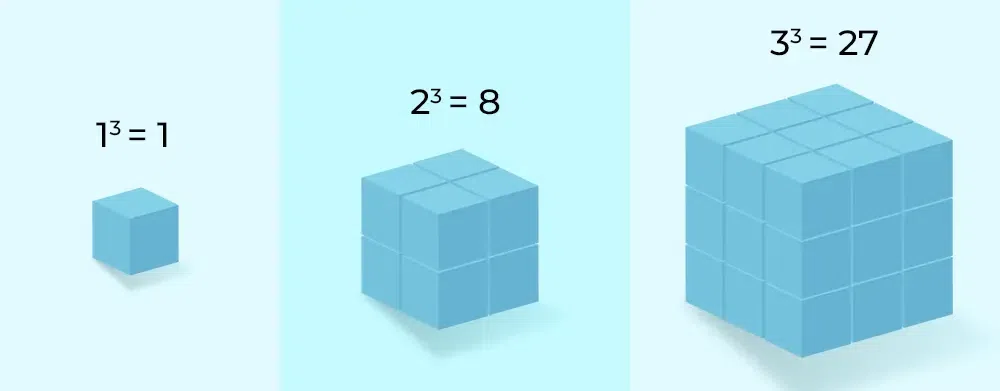
- When a number is multiplied by itself three times, the product is called the cube of that number.
- Cube of a number ‘a’ is written as a³.
- Formula: a³ = a × a × a Example: 2³ = 2 × 2 × 2 = 8 5³ = 5 × 5 × 5 = 125 10³ = 10 × 10 × 10 = 1000
2. Properties of Cubes
- Cubes of even numbers are always even. Ex: 4³ = 64 (even), 6³ = 216 (even)
- Cubes of odd numbers are always odd. Ex: 3³ = 27 (odd), 7³ = 343 (odd)
- Cubes of negative numbers are negative. Ex: (-2)³ = -8, (-5)³ = -125
- Cube of 0 is 0.
- The cube of a number ending with 0 ends with 0. Ex: 10³ = 1000, 20³ = 8000
3. Interesting Patterns in Units Digit of Cubes
The units digit of a cube depends only on the units digit of the original number:
| Units digit of number | Units digit of its cube |
|---|---|
| 0 | 0 |
| 1 | 1 |
| 2 | 8 |
| 3 | 7 |
| 4 | 4 |
| 5 | 5 |
| 6 | 6 |
| 7 | 3 |
| 8 | 2 |
| 9 | 9 |
Very useful for quick mental calculation and finding cube roots.
4. Perfect Cubes
- A natural number is called a perfect cube if it is the cube of some natural number.
- Examples: 1, 8, 27, 64, 125, 216, 343, 512, 729, 1000, … are perfect cubes.
- These are cubes of 1, 2, 3, 4, 5, 6, 7, 8, 9, 10, …
5. Cube Roots
- The cube root of a number ‘x’ is a number which when multiplied by itself three times gives ‘x’.
- Symbol: ∛x or x^(1/3)
- Example: ∛8 = 2 (because 2 × 2 × 2 = 8) ∛125 = 5 ∛1000 = 10 ∛(-64) = -4 (cube root of negative number is negative)
6. Cube Root of a Perfect Cube
- Every perfect cube has an exact cube root which is an integer.
- Cube root of non-perfect cubes is generally not an integer (e.g., ∛2 ≈ 1.26).
7. Method 1: Finding Cube Root by Prime Factorisation
Steps:
- Express the number as a product of prime factors.
- Make groups of three identical factors.
- Take one factor from each group and multiply them. That gives the cube root.
Example 1: Find ∛(3375) 3375 = 3 × 3 × 3 × 5 × 5 × 5 = 3³ × 5³ ∛3375 = 3 × 5 = 15
Example 2: ∛(21952) 21952 = 2 × 2 × 2 × 13 × 13 × 13 = 2³ × 13³ ∛21952 = 2 × 13 = 26
Example 3: ∛(1728) 1728 = 2³ × 2³ × 3³ = (2 × 2 × 3)³ = 12³ ∛1728 = 12
8. Method 2: Estimation Method (Short-cut for Cube Roots of Perfect Cubes)
This is the fastest method for large perfect cubes in exams.
Steps:
- Look at the units digit of the number and match it with the units digit table (above) to find possible units digit of cube root.
- Remove the last three digits (thousands place and beyond) and look at the remaining number.
- Find between which two cubes it lies.
- Choose the smaller or larger number accordingly.
Example: Find ∛(59319) Step 1: Units digit = 9 → cube root must end with 9 (only 9³ ends with 9) Step 2: Remove last three digits → 59 Step 3: Find cubes: 3³ = 27 4³ = 64 So 27 < 59 < 64 → cube root lies between 30 and 40 Step 4: Since we already know units digit is 9 → answer = 39 Verification: 39³ = 39 × 39 × 39 = 1521 × 39 = 59319 ✓
Another Example: ∛(91125)
- Units digit 5 → cube root ends with 5
- Remove last 3 digits → 91
- 4³ = 64, 5³ = 125 → 64 < 91 < 125 → tens digit = 4
- So cube root = 45 Check: 45³ = 45 × 45 × 45 = 2025 × 45 = 91125 ✓
9. Quick Reference Table of Cubes (1 to 20) – Must Memorise
| Number | Cube | Number | Cube |
|---|---|---|---|
| 1 | 1 | 11 | 1331 |
| 2 | 8 | 12 | 1728 |
| 3 | 27 | 13 | 2197 |
| 4 | 64 | 14 | 2744 |
| 5 | 125 | 15 | 3375 |
| 6 | 216 | 16 | 4096 |
| 7 | 343 | 17 | 4913 |
| 8 | 512 | 18 | 5832 |
| 9 | 729 | 19 | 6859 |
| 10 | 1000 | 20 | 8000 |
10. Cube Roots of Numbers Less Than 1 (Decimals)
- ∛0.001 = 0.1 (because 0.1 × 0.1 × 0.1 = 0.001)
- ∛0.000027 = 0.03
- ∛0.216 = 0.6
11. Cube Root of Product and Quotient
- ∛(a × b) = ∛a × ∛b
- ∛(a / b) = ∛a / ∛b (b ≠ 0)
12. Important Points for Exams
- If a number has 4 or 5 digits → cube root has 2 digits.
- If a number has 6 or 7 digits → cube root has 3 digits.
- Always check if the number is a perfect cube by estimation method first.
- For non-perfect cubes, we usually say cube root is not an integer (unless asked for approximate value).
13. Summary Table for Quick Revision
| Concept | Key Point |
|---|---|
| Cube of a number | a × a × a = a³ |
| Cube of even number | Even |
| Cube of odd number | Odd |
| Cube of negative number | Negative |
| Cube root symbol | ∛ |
| Method 1 | Prime factorisation |
| Method 2 | Estimation (units digit + range) |
| Memorise cubes 1–20 | Yes (very important) |
| Units digit rule | Use table given above |
Download pdf notes and Sulutions of the Chapter:
Please Visit Readspot for Hindi Medium Study Material

You may also like

Chapter 1: Rational Numbers

Chapter 2: Linear Equations in One Variable
