
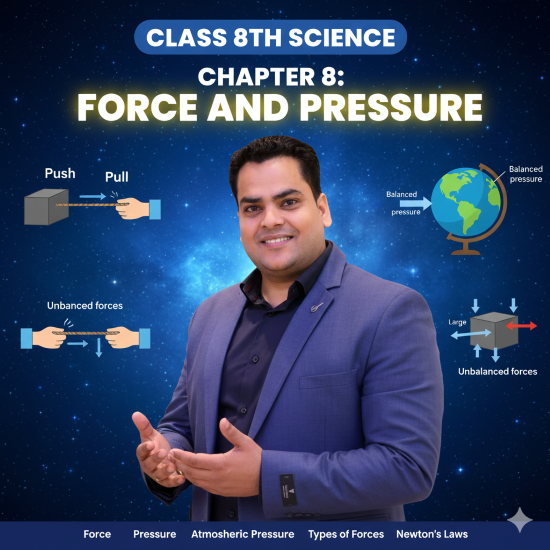
Chapter 8: Force and Pressure
Chapter 8: Force and Pressure
Introduction to Force and Pressure:
These notes of Force and Pressure, cover the entire chapter as per latest CBSE NCERT textbook (2023-24 onwards). Use diagrams from textbook (force arrows, pressure in liquids, crushing can) for better understanding.
1. Force – A Push or a Pull
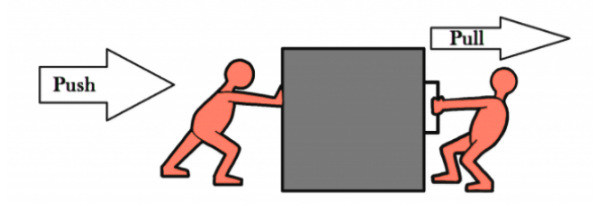
- Force is an interaction that can change the state of motion or shape of an object.
- It is a push or a pull acting on an object.
- Force has both magnitude (how strong) and direction → It is a vector quantity.
- Unit: Newton (N). 1 Newton ≈ force required to accelerate 1 kg mass by 1 m/s².
- Measured by: Spring balance.
Types of Forces
A. Contact Forces (require physical touch)
- Muscular force – Force applied by muscles (e.g., lifting bag, kicking ball).
- Friction – Opposes relative motion between surfaces (e.g., brakes of car).
- Normal force – Perpendicular force by surface (e.g., table supporting book).
- Tension – Force in ropes/strings when pulled.
- Applied force – Direct push/pull by a person or object.
B. Non-contact Forces (act from a distance)
- Gravitational force – Attraction between masses (e.g., apple falling).
- Electrostatic force – Between charged objects (e.g., comb attracting paper bits).
- Magnetic force – Between magnets or magnet and iron (e.g., fridge magnet).
Effects of Force (What a force can do)
- Change the state of rest or motion (start/stop/change speed).
- Change direction of motion (e.g., steering a bicycle).
- Change shape or size (e.g., squeezing sponge, stretching rubber band).
Net Force (Resultant Force)
- When many forces act on an object, the overall effect depends on the net force.
- Balanced forces → Net force = 0 → No change in motion (object at rest stays at rest or uniform motion continues).
- Unbalanced forces → Net force ≠ 0 → Acceleration or change in motion.
Example: Tug-of-war
- If both teams pull equally → rope does not move (balanced forces).
- If one team pulls harder → rope moves towards stronger team (unbalanced).
2. Exploring Forces
- A force can act only when objects interact.
- Every action has an equal and opposite reaction (Newton’s Third Law – introduced here qualitatively).
- Forces always occur in pairs (action-reaction pair).
Example:
- When you walk, your foot pushes the ground backward (action), ground pushes your foot forward (reaction).
3. Pressure
- Pressure is force acting per unit area.
- Pressure = Thrust (Force) / Area Formula: P = F / A where P = pressure, F = force (in Newton), A = area (in m²)
- Unit of pressure: Pascal (Pa) 1 Pascal = 1 Newton per square metre (1 N/m²)
- Larger area → less pressure for same force Smaller area → more pressure for same force
Why sharp knife cuts better than blunt knife?
- Same force acts on smaller area of sharp edge → higher pressure → cuts easily.
Examples of Pressure in Daily Life
- School bags have broad straps → Larger area → less pressure on shoulders → comfortable.
- Camel walks easily on sand → Wide feet → large area → less pressure → does not sink.
- Elephant’s feet are broad and padded → Reduces pressure on ground.
- Foundation of buildings is wide → Weight spreads over large area → less pressure on soil.
- Cutting tools have sharp edges → Small area → high pressure.
- Tractor tyres are wide → Less pressure on soil → prevents sinking.
Pressure Exerted by Liquids and Gases (Fluid Pressure)
- Fluids (liquids and gases) exert pressure in all directions.
- Liquid pressure increases with depth.
- Pressure at a point in liquid depends on: (i) Depth (h) below the surface (ii) Density (ρ) of liquid (iii) Acceleration due to gravity (g)
Formula: Pressure = ρ × g × h (ρgh formula is introduced conceptually; exact derivation not required)
Why dams have broader base at bottom?
- Water pressure is higher at greater depth → walls made thicker at bottom to withstand higher pressure.
Atmospheric Pressure
- Air around us has weight → exerts pressure in all directions.
- Atmospheric pressure is maximum at sea level and decreases with altitude.
- Demonstrated by: Crushing can experiment (when hot can with steam is cooled, air pressure outside crushes it).
Important Experiments/Activities
- Crushing can → Shows atmospheric pressure is huge.
- Magdeburg hemisphere → Two hemispheres joined, air removed → horses cannot separate → high atmospheric pressure.
- Drinking straw → You don’t suck juice up; atmospheric pressure pushes liquid into straw when you reduce pressure inside mouth.
Key Points Table
| Concept | Formula | Depends on | Example |
|---|---|---|---|
| Force | – | Magnitude + Direction | Pushing a cart |
| Pressure | P = F/A | Force, Area | Sharp pin pierces easily |
| Liquid Pressure | P = ρgh | Density, gravity, depth | Dam walls thicker at bottom |
| Atmospheric Pressure | Varies with height | Altitude | Boiling point lower on mountains |
Quick Revision Points
- Force cannot be seen but its effects can be seen.
- Force may produce change in speed, direction, or shape.
- Non-contact forces: Gravitational, Magnetic, Electrostatic.
- Pressure is scalar quantity (only magnitude).
- Same force → larger area → less pressure.
- Liquids and gases exert pressure on walls of container too (sideways and upwards also).
- At same depth, pressure is same in all directions.
- Air pressure decreases as we go higher (less air above).
Common NCERT Questions (Expected)
- Give two examples each of situations where you push or pull.
- Why do mountaineers carry oxygen cylinders? → Less atmospheric pressure at high altitude → less oxygen.
- Why is it easier to walk on soft sand with flat shoes than pointed heels?
- Explain why porters place round piece of cloth on head when carrying heavy load.
- Why cutting tools have sharp edges?
- How does liquid pressure depend on depth?
Download pdf notes and Sulutions of the Chapter:
Please Visit Readspot for Hindi Medium Study Material

You may also like

Chapter 1: Crop Production and Management
26 November, 2025

Chapter 2: Microorganisms Friend and Foe
26 November, 2025
Chapter 3: Coal and Petroleum
26 November, 2025