
Chapter 9: Friction
CBSE Class 8 Science – Chapter 9: Friction
Introduction to Friction
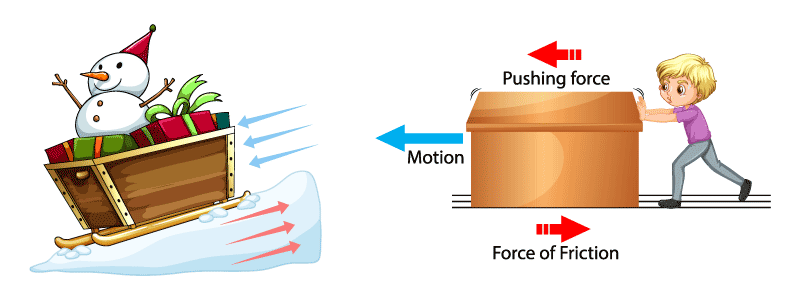
- Friction is a force that opposes the relative motion between two surfaces in contact.
- It always acts in the direction opposite to the direction of motion or intended motion.
- It is a contact force (needs physical touch between surfaces).
- Friction is a self-adjusting force (it adjusts its value up to a certain limit).
Cause of Friction
- Even smooth-looking surfaces have microscopic irregularities (hills and valleys).
- When two surfaces are in contact, these irregularities interlock, opposing motion.
- Greater the roughness → greater the friction.
Types of Friction
- Static Friction
- Friction that acts when an object is at rest and we try to move it.
- It is the strongest type of friction.
- It prevents objects from starting to move.
- Maximum static friction is called limiting friction.
- Static friction ≥ sliding friction.
- Sliding Friction
- Friction when one object slides over another.
- It is weaker than static friction.
- Example: Pushing a heavy box (initially hard, becomes easier once it starts moving).
- Rolling Friction
- Friction when an object rolls over a surface.
- It is the weakest type of friction.
- Example: Wheels of vehicles, ball bearings.
- Rolling friction < Sliding friction < Static friction.
Factors Affecting Friction
- Nature of surfaces in contact
- Rough surfaces → more friction
- Smooth surfaces → less friction
- Normal force (force pressing the surfaces together)
- Heavier object → more normal force → more friction
- Area of contact (does not affect friction much if normal force is same)
Friction – A Necessary Evil
Friction is both useful and harmful.
Advantages of Friction (Why it is necessary)
- Walking – Friction between shoes and ground helps us walk without slipping.
- Writing – Friction between pencil and paper allows writing.
- Holding objects – We can grip things because of friction.
- Brakes in vehicles – Friction stops moving vehicles.
- Nails and screws stay in wood due to friction.
- Matchstick lights when rubbed (friction produces heat).
- Belt drive, clutches in machines work due to friction.
Disadvantages of Friction (Why it is an evil)
- Wear and tear of machine parts, soles of shoes, tyres.
- Produces heat → energy loss in machines.
- Reduces efficiency of machines.
- Slows down moving objects.
- Causes bush fires when dry branches rub.
Ways to Reduce Friction
- Polishing – Makes surfaces smoother.
- Lubricants (oil, grease, graphite) – Form a thin layer between surfaces.
- Ball bearings – Convert sliding into rolling friction.
- Streamlining – Reduces fluid friction (air/water resistance).
- Using wheels – Rolling friction is much less than sliding friction.
Ways to Increase Friction
- Making surfaces rough – Grooves on tyres, patterns on shoe soles.
- Using brake pads in vehicles.
- Spreading sand on slippery roads.
- Increasing weight (increases normal force).
Fluid Friction (Drag)
- Friction exerted by liquids and gases is called drag.
- It opposes motion through fluids.
- Depends on:
- Speed of object
- Shape of object
- Nature and density of fluid
- Streamlined shape (like fish, aeroplane, birds) reduces drag.
- Objects falling in air reach terminal velocity when drag = weight.
Key Examples from Daily Life
- It is easier to push a box already in motion than to start it → sliding friction < static friction.
- Cyclists bend forward → reduces air drag.
- Aeroplanes, ships, cars have streamlined shapes.
- Kabaddi players rub hands with soil → increases friction to grip opponent.
- Gymnasts apply coarse powder → better grip on bars.
Important Definitions
- Friction: Force that opposes relative motion between two surfaces.
- Static friction: Friction before motion starts.
- Limiting friction: Maximum value of static friction.
- Sliding friction: Friction during sliding motion.
- Rolling friction: Friction during rolling.
- Drag: Friction by fluids.
- Lubrication: Use of lubricants to reduce friction.
Quick Comparison Table
| Type of Friction | Strength | Example |
|---|---|---|
| Static Friction | Strongest | Object at rest, about to move |
| Sliding Friction | Medium | Box sliding on floor |
| Rolling Friction | Weakest | Car moving on road with wheels |
Some Important Points for Exams
- Friction depends on roughness of surfaces and normal force, not on area of contact (for same normal force).
- Rolling friction is least → wheels are used in vehicles.
- Friction produces heat (rubbing hands, drilling, meteor burning).
- In space there is no air → no fluid friction → objects keep moving forever once started (Newton’s first law).
- Powder (talcum) on carrom board reduces friction → striker moves smoothly.
Key Diagrams to Draw in Exam
- Irregularities on surfaces interlocking.
- Force of friction opposite to applied force.
- Ball bearings.
- Streamlined vs non-streamlined shapes.
- Brake system (friction between brake pad and wheel).
Summary
Friction is a force that opposes motion. It has three types: static (strongest), sliding, and rolling (weakest). It is caused by interlocking of irregularities on surfaces. Friction is both useful (walking, braking, holding) and harmful (wear and tear, energy loss). We reduce unwanted friction by polishing, lubricants, ball bearings, streamlining. We increase friction when needed by roughening surfaces or increasing weight. Fluid friction (drag) is minimized by streamlined shapes.
Download pdf notes and Sulutions of the Chapter:
Please Visit Readspot for Hindi Medium Study Material

You may also like

Chapter 1: Crop Production and Management
26 November, 2025

Chapter 2: Microorganisms Friend and Foe
26 November, 2025
Chapter 3: Coal and Petroleum
26 November, 2025