
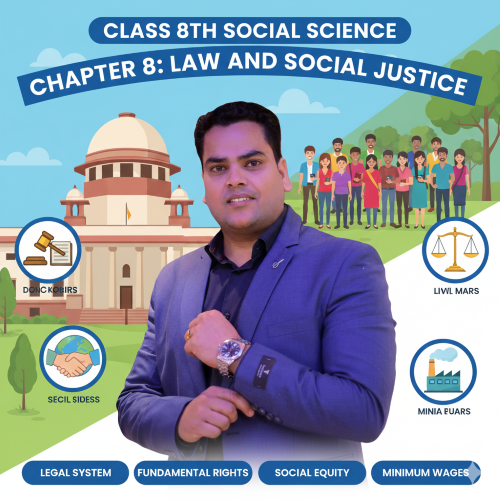
Chapter 8: Law and Social Justice
CBSE Class 8 Civics Chapter 8: Law and Social Justice
Introduction to Law and Social Justice
These notes of Chapter 8: Law and Social Justice, cover the entire chapter with all examples, laws, and concepts asked in CBSE Class 8 exams. Revise with textbook diagrams (Bhopal map, worker photos, consumer court structure) for better marks.
- Every day we see workers being exploited, environments getting polluted, and consumers cheated by companies, yet markets continue to work.
- To protect people from such exploitation, the government makes certain laws.
- One of the major objectives of these laws is to ensure social justice.
- Social justice means equal treatment of all citizens and protection of the weak from the powerful.
What is a Law?
- A law is a system of rules made by the government that citizens must follow.
- Laws are enforced through government agencies (police, courts, etc.).
- Laws keep changing with time according to the needs of society.
Why do we need Laws for Social Justice?
- Markets only look after the interests of the rich and powerful producers.
- Poor workers, consumers, and the environment are often exploited for more profit.
- Example: Child labour, low wages, unsafe working conditions, pollution, fake products, etc.
- Laws protect the interests of workers, consumers, and the environment and ensure dignity and justice.
Worker’s Worth Less Than a Machine? (Case Study)
- In India, many factories treat workers very badly to reduce costs and increase profit.
- Common violations:
- Very low wages (sometimes ₹50–80 per day)
- No fixed working hours (12–16 hours a day)
- No weekly holidays or leave
- Dangerous working conditions (no ventilation, fire exits, safety equipment)
- Employment of children below 14 years
- Employers often say: “If we give high wages and good conditions, we will not be able to sell at low prices and will shut down.”
- This is exploitation of workers for private profit.
Laws to Protect Workers
- Minimum Wages Act
- Government fixes minimum wages for different jobs in different states and for different types of work.
- Example (2024–25 rates vary): Delhi – unskilled ₹17,494/month, Uttar Pradesh – unskilled ₹8,500–10,000/month approx.
- Payment of Wages Act, Factories Act, etc.
- Wages must be paid on time, overtime must be paid extra.
- Child Labour (Prohibition and Regulation) Act, 1986 (amended 2016)
- Children below 14 years cannot work in hazardous industries (mines, factories, bidi-making, etc.).
- Children 14–18 years are adolescents and also banned from hazardous jobs.
- Right to Safe Working Conditions
- Factories must have proper ventilation, drinking water, creche if more than 30 women workers, first-aid, fire extinguishers, etc.
- Contract Labour Laws
- Contract workers must also get fair wages and facilities.
Enforcement of Laws – The Big Problem
- Laws exist, but they are not properly enforced.
- Reasons:
- Lack of awareness among workers
- Fear of losing job
- Corruption and pressure from powerful employers
- Shortage of inspectors (in government
- Example: In 2020–21, India had only about 8,000–9,000 factory inspectors for lakhs of factories.
- Result: Violations continue even after laws are made.
Bhopal Gas Tragedy – The Worst Industrial Disaster (1984)
- Union Carbide (American company) pesticide plant in Bhopal leaked deadly Methyl Isocyanate (MIC) gas on night of 2–3 December 1984.
- Immediate deaths: 3,000–4,000
- Total deaths over years: 15,000–20,000
- Lakhs of people suffered blindness, lung damage, cancer, and birth defects.
- The factory had many safety violations:
- No proper safety systems
- Stored huge quantities of MIC
- Located near densely populated area
- Company paid only $470 million compensation (very less compared to damage).
- Case continued in courts for decades; CEO Warren Anderson never faced trial in India.
New Laws to Protect Environment
After Bhopal disaster, government passed stricter laws:
- Environment Protection Act, 1986
- Central government got power to protect and improve environment.
- Right to Life (Article 21)
- Supreme Court said clean environment is part of Right to Life.
- Polluter Pays Principle
- Whoever causes pollution must pay for cleaning and compensation.
- Public Liability Insurance Act, 1991
- Hazardous industries must take insurance to pay immediate relief.
- National Green Tribunal (NGT) 2010
- Special court for fast disposal of environment cases.
Consumer Rights and Laws
Consumers are also exploited through:
- Underweight goods
- Overpricing
- Adulteration (mixing harmful things)
- Fake brands
- False advertisements
Consumer Protection Act, 2019 (COPRA)
- Replaced 1986 Act; stronger rights.
- Six consumer rights:
- Right to Safety
- Right to be Informed
- Right to Choose
- Right to be Heard
- Right to Seek Redressal
- Right to Consumer Education
- Three-tier redressal system:
- District Consumer Disputes Redressal Commission (up to ₹1 crore)
- State Commission (₹1–10 crore)
- National Commission (above ₹10 crore)
- Consumer can file case easily; no big lawyer needed.
- Example: If a company sells expired medicine, consumer can demand replacement + compensation.
How to Make Markets Work for Social Justice
- Strong Laws – Keep updating laws as new problems come.
- Proper Enforcement – More inspectors, strict punishment, online complaint systems.
- Role of Citizens – Be aware, form associations, file RTI, approach consumer courts.
- Role of Government – Fix fair prices for essential goods, give subsidies to poor, punish violators.
- Role of Workers & Consumers – Unite and raise voice (unions, consumer forums).
Conclusion
- Markets alone cannot ensure social justice.
- Laws are necessary to protect workers, consumers, and the environment from exploitation.
- But laws are useful only when they are properly enforced.
- Every citizen has a responsibility to demand enforcement of laws and report violations.
- Only then can we build a just and dignified society.
Important Terms to Remember
- Social Justice – Equal treatment and protection of weak sections.
- Exploitation – Taking unfair advantage of workers/consumers.
- Minimum Wages – Lowest wage government allows employer to pay.
- Hazardous Industries – Work that can harm health (chemicals, mines, etc.).
- Pollution – Contamination of air, water, soil.
- Consumer Rights – Legal rights of buyers against unfair trade practices.
- Enforcement – Making sure laws are actually followed.
Key Years
- 1984 → Bhopal Gas Tragedy
- 1986 → Environment Protection Act & Consumer Protection Act (old)
- 2016 → Child Labour Amendment
- 2019 → New Consumer Protection Act
Download pdf notes and Sulutions of the Chapter:
Please Visit Readspot for Hindi Medium Study Material

You may also like
Chapter 6: Civilising the “Native”, Educating the Nation
14 December, 2025
Chapter 7: Women,Caste and Reform
14 December, 2025
Chapter 8: The Making of the National Movement
14 December, 2025