
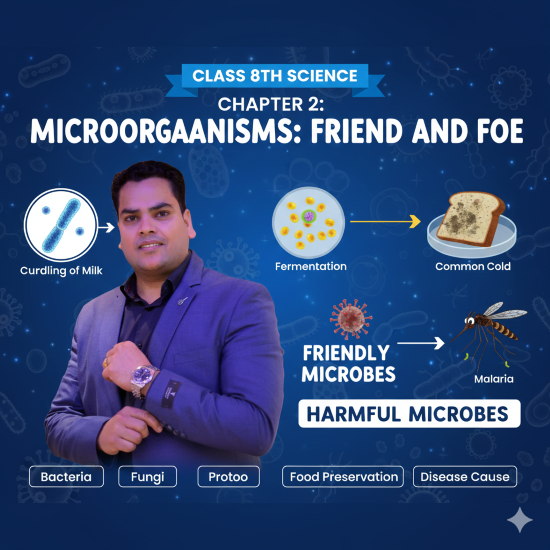
Chapter 2: Microorganisms Friend and Foe
Chapter 2: Microorganisms Friend and Foe
Introduction to Microorganisms Friend and Foe:
These notes of Microorganisms Friend and Foe, cover the entire chapter comprehensively for CBSE Class 8 exams. Revise diagrams and examples thoroughly!
1.Microorganisms:
- Microorganisms (microbes) are very tiny living organisms that cannot be seen with the naked eye.
- They can only be seen under a microscope.
- They are present everywhere – air, water, soil, inside our body, on our skin, and even inside other animals and plants.
- Size: Generally 1 micron (1/1000 mm) to a few microns.
- Discovered by Antonie van Leeuwenhoek (called them “animalcules”).
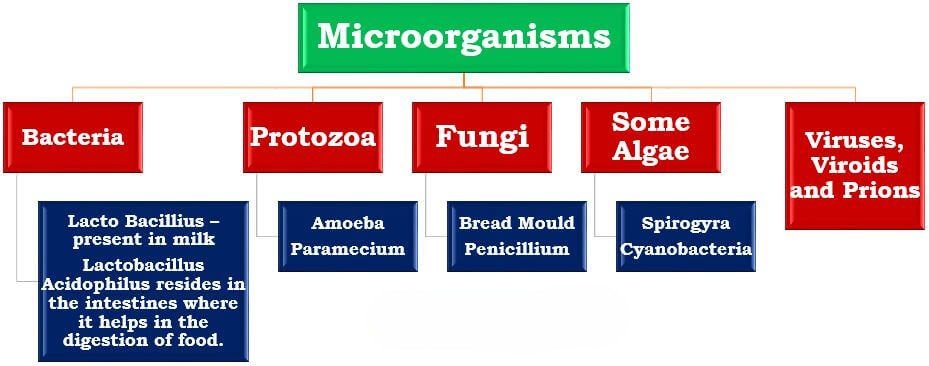
2. Major Groups of Microorganisms
There are five major groups:Microorganisms: Friend and Foe
- Bacteria
- Single-celled organisms.
- Shapes: Spherical (cocci), rod-shaped (bacilli), spiral (spirilla), comma-shaped (vibrio).
- Can survive in extreme conditions (hot springs, ice, deep inside earth).
- Examples: Lactobacillus (curd formation), Rhizobium (nitrogen fixation), E. coli (in intestine).
- Viruses
- Non-living outside a host, living inside a host.
- They reproduce only inside living cells.
- Cause diseases like common cold, influenza, dengue, AIDS, polio, chickenpox.
- Very small (20–400 nm); visible only under electron microscope.
- Fungi
- Mostly multicellular (except yeast which is unicellular).
- Do not contain chlorophyll → cannot make their own food → saprophytic or parasitic.
- Examples: Yeast, Moulds (Penicillium), Mushrooms, Bread mould (Rhizopus).
- Protozoa
- Single-celled eukaryotic organisms.
- Mostly found in water bodies.
- Move with the help of pseudopodia (Amoeba), cilia (Paramecium), or flagella.
- Examples: Amoeba, Paramecium, Plasmodium (causes malaria).
- Algae
- Mostly aquatic, contain chlorophyll → can photosynthesise.
- Unicellular (Chlamydomonas) or multicellular (Spirogyra, Seaweeds).
- Examples: Spirogyra, Chlorella, Anabaena.
3. Where do Microorganisms Live?
- Microbes are found in all kinds of habitats: → Extremely hot (thermophiles) → Extremely cold (psychrophiles) → High salinity (halophiles) → Acidic or alkaline environments
- Soil: Bacteria, fungi, protozoa.
- Water: Algae, protozoa, some bacteria.
- Air: Spores of fungi and bacteria, viruses.
- Inside human body: Around 10¹³ human cells vs 10¹⁴ bacterial cells (mostly useful).
4. Microorganisms as Friends (Useful Microorganisms)
A. Commercial Use
- Making curd: Lactobacillus (LAB – Lactic Acid Bacteria) converts milk sugar (lactose) into lactic acid → milk proteins coagulate → curd.
- Making alcohol and wine: Yeast (Saccharomyces cerevisiae) ferments sugar → alcohol + CO₂ (anaerobic respiration).
- Bread making: Yeast ferments dough → releases CO₂ → dough rises → soft and spongy bread.
- Production of antibiotics: Penicillium notatum → Penicillin (discovered by Alexander Fleming).
B. In Agriculture
- Nitrogen fixation:
- Free-living: Azotobacter, Anabaena.
- Symbiotic: Rhizobium in root nodules of leguminous plants (pea, gram, beans).
- Converts atmospheric N₂ into usable compounds.
- Blue-green algae (cyanobacteria) increase soil fertility.
C. In Environment
- Decomposers: Bacteria and fungi decompose dead plants and animals → convert complex organic matter into simple substances → maintain nutrient cycle (carbon, nitrogen cycle).
- Sewage treatment: Aerobic and anaerobic bacteria break down organic waste.
5. Microorganisms as Foe (Harmful Microorganisms)
A. Human Diseases
- Bacterial: Tuberculosis, Typhoid, Cholera, Tetanus, Anthrax.
- Viral: Polio, Chickenpox, Measles, Hepatitis, AIDS, Dengue.
- Protozoan: Malaria (Plasmodium), Amoebic dysentery, Sleeping sickness.
- Fungal: Ringworm, Athlete’s foot.
B. Animal Diseases
- Anthrax (cattle), Foot and mouth disease.
C. Plant Diseases
- Citrus canker (bacteria), Rust of wheat (fungi), Yellow vein mosaic of bhindi (virus).
D. Food Spoilage
- Bacteria and fungi grow on food (bread, pickles, fruits) in moist and warm conditions → produce bad smell and taste → food becomes unfit.
6. Disease Transmission (Carriers)
- Housefly: Carries germs from garbage and animal excreta to food.
- Female Anopheles mosquito: Carries Plasmodium (malaria parasite).
- Female Aedes mosquito: Dengue and chikungunya virus.
7. Methods of Food Preservation
To stop growth of harmful microbes:
- Pasteurisation: Milk is heated to 70°C for 15–30 seconds and then suddenly chilled → kills harmful bacteria.
- Drying: Removes moisture (sun-drying of grains, fish, spices).
- Salting: High salt concentration (pickles, fish).
- Adding sugar: High sugar concentration (jams, jellies).
- Adding oil and vinegar: Prevents air contact (pickles).
- Refrigeration/Freezing: Low temperature slows microbial growth.
- Canning and vacuum packing.
8. Nitrogen Cycle (Role of Microorganisms)
- Atmospheric nitrogen (78%) cannot be used directly by plants.
- Steps:
- Nitrogen fixation: Rhizobium, Azotobacter, lightning → convert N₂ into nitrates.
- Plants absorb nitrates → make proteins.
- Animals eat plants → get nitrogen.
- Death and decay → decomposers (bacteria, fungi) convert proteins → ammonia.
- Nitrifying bacteria (Nitrosomonas, Nitrobacter) convert ammonia → nitrites → nitrates.
- Denitrifying bacteria return nitrogen back to atmosphere.
Key Diagrams to Draw (Important for Exams)
- Shapes of bacteria (cocci, bacilli, spirilla, vibrio).
- Amoeba, Paramecium.
- Bread mould (Rhizopus) showing sporangia.
- Nitrogen cycle (flow chart).
- Fermentation by yeast.
Important Examples Table
| Microorganism | Friendly Role | Harmful Role |
|---|---|---|
| Bacteria | Curd, nitrogen fixation, antibiotics | Cholera, TB, food spoilage |
| Yeast | Bread, alcohol | Rarely harmful |
| Fungi | Antibiotics (Penicillin), decomposition | Ringworm, food spoilage |
| Viruses | None (always harmful to host) | Cold, flu, AIDS, polio |
| Algae | Oxygen production, food (Spirulina) | Algal blooms (water pollution) |
Quick Revision Points
- Microbes are both friends and foes depending on where and how they act.
- Antibiotics work only against bacteria, not viruses.
- Vaccines give immunity against many viral and bacterial diseases.
- Louis Pasteur discovered pasteurisation and rabies vaccine.
- Edward Jenner developed the first vaccine (smallpox).
Download pdf notes and Sulutions of the Chapter:
Please Visit Readspot for Hindi Medium Study Material

You may also like

Chapter 1: Crop Production and Management
26 November, 2025
Chapter 3: Coal and Petroleum
26 November, 2025

Chapter 4: Combustion and Flame
26 November, 2025