
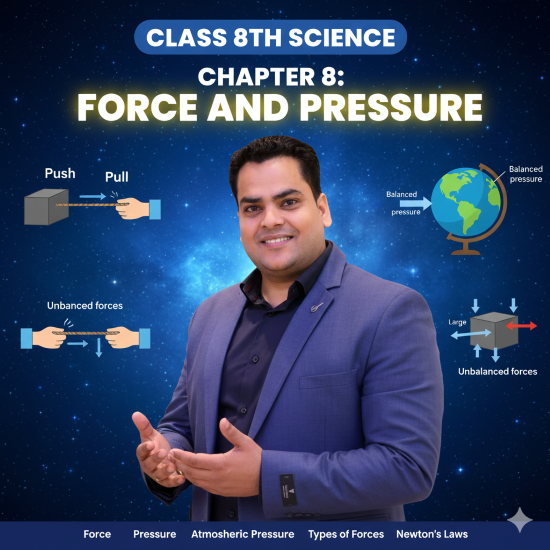
Chapter 8 Force and Pressure Class 8 Notes | CBSE & NCERT
Chapter 8: Force and Pressure
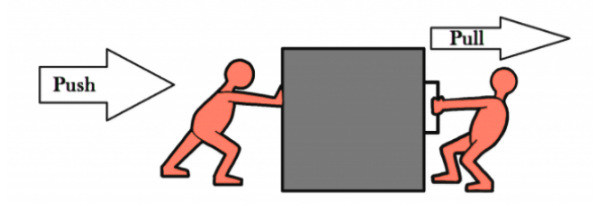
Introduction to Force and Pressure:
These notes of Force and Pressure, cover the entire chapter as per latest CBSE NCERT textbook (2023-24 onwards). Use diagrams from textbook (force arrows, pressure in liquids, crushing can) for better understanding.
1. Force – A Push or a Pull
- Force is an interaction that can change the state of motion or shape of an object.
- It is a push or a pull acting on an object.
- Force has both magnitude (how strong) and direction → It is a vector quantity.
- Unit: Newton (N). 1 Newton ≈ force required to accelerate 1 kg mass by 1 m/s².
- Measured by: Spring balance.
Types of Forces
A. Contact Forces (require physical touch)
- Muscular force – Force applied by muscles (e.g., lifting bag, kicking ball).
- Friction – Opposes relative motion between surfaces (e.g., brakes of car).
- Normal force – Perpendicular force by surface (e.g., table supporting book).
- Tension – Force in ropes/strings when pulled.
- Applied force – Direct push/pull by a person or object.
B. Non-contact Forces (act from a distance)
- Gravitational force – Attraction between masses (e.g., apple falling).
- Electrostatic force – Between charged objects (e.g., comb attracting paper bits).
- Magnetic force – Between magnets or magnet and iron (e.g., fridge magnet).
Effects of Force (What a force can do)
- Change the state of rest or motion (start/stop/change speed).
- Change direction of motion (e.g., steering a bicycle).
- Change shape or size (e.g., squeezing sponge, stretching rubber band).
Net Force (Resultant Force)
- When many forces act on an object, the overall effect depends on the net force.
- Balanced forces → Net force = 0 → No change in motion (object at rest stays at rest or uniform motion continues).
- Unbalanced forces → Net force ≠ 0 → Acceleration or change in motion.
Example: Tug-of-war
- If both teams pull equally → rope does not move (balanced forces).
- If one team pulls harder → rope moves towards stronger team (unbalanced).
2. Exploring Forces
- A force can act only when objects interact.
- Every action has an equal and opposite reaction (Newton’s Third Law – introduced here qualitatively).
- Forces always occur in pairs (action-reaction pair).
Example:
- When you walk, your foot pushes the ground backward (action), ground pushes your foot forward (reaction).
3. Pressure
- Pressure is force acting per unit area.
- Pressure = Thrust (Force) / Area Formula: P = F / A where P = pressure, F = force (in Newton), A = area (in m²)
- Unit of pressure: Pascal (Pa) 1 Pascal = 1 Newton per square metre (1 N/m²)
- Larger area → less pressure for same force Smaller area → more pressure for same force
Why sharp knife cuts better than blunt knife?
- Same force acts on smaller area of sharp edge → higher pressure → cuts easily.
Examples of Pressure in Daily Life
- School bags have broad straps → Larger area → less pressure on shoulders → comfortable.
- Camel walks easily on sand → Wide feet → large area → less pressure → does not sink.
- Elephant’s feet are broad and padded → Reduces pressure on ground.
- Foundation of buildings is wide → Weight spreads over large area → less pressure on soil.
- Cutting tools have sharp edges → Small area → high pressure.
- Tractor tyres are wide → Less pressure on soil → prevents sinking.
Pressure Exerted by Liquids and Gases (Fluid Pressure)
- Fluids (liquids and gases) exert pressure in all directions.
- Liquid pressure increases with depth.
- Pressure at a point in liquid depends on: (i) Depth (h) below the surface (ii) Density (ρ) of liquid (iii) Acceleration due to gravity (g)
Formula: Pressure = ρ × g × h (ρgh formula is introduced conceptually; exact derivation not required)
Why dams have broader base at bottom?
- Water pressure is higher at greater depth → walls made thicker at bottom to withstand higher pressure.
Atmospheric Pressure
- Air around us has weight → exerts pressure in all directions.
- Atmospheric pressure is maximum at sea level and decreases with altitude.
- Demonstrated by: Crushing can experiment (when hot can with steam is cooled, air pressure outside crushes it).
Important Experiments/Activities
- Crushing can → Shows atmospheric pressure is huge.
- Magdeburg hemisphere → Two hemispheres joined, air removed → horses cannot separate → high atmospheric pressure.
- Drinking straw → You don’t suck juice up; atmospheric pressure pushes liquid into straw when you reduce pressure inside mouth.
Key Points Table
| Concept | Formula | Depends on | Example |
|---|---|---|---|
| Force | – | Magnitude + Direction | Pushing a cart |
| Pressure | P = F/A | Force, Area | Sharp pin pierces easily |
| Liquid Pressure | P = ρgh | Density, gravity, depth | Dam walls thicker at bottom |
| Atmospheric Pressure | Varies with height | Altitude | Boiling point lower on mountains |
Quick Revision Points
- Force cannot be seen but its effects can be seen.
- Force may produce change in speed, direction, or shape.
- Non-contact forces: Gravitational, Magnetic, Electrostatic.
- Pressure is scalar quantity (only magnitude).
- Same force → larger area → less pressure.
- Liquids and gases exert pressure on walls of container too (sideways and upwards also).
- At same depth, pressure is same in all directions.
- Air pressure decreases as we go higher (less air above).
FAQs
What is force in Class 8 Science?
Force is a push or pull acting on an object that can change its motion, direction, or shape.
What is pressure?
Pressure is the force acting per unit area on the surface of an object.
What are the effects of force?
A force can:
- Change speed
- Change direction
- Change shape
- Stop or start motion
What is atmospheric pressure?
Atmospheric pressure is the pressure exerted by the air surrounding the Earth.
Which chapter is Force and Pressure?
Force and Pressure is Chapter 8 of Class 8 Science (NCERT/CBSE)
Common NCERT Questions (Expected)
- Give two examples each of situations where you push or pull.
- Why do mountaineers carry oxygen cylinders? → Less atmospheric pressure at high altitude → less oxygen.
- Why is it easier to walk on soft sand with flat shoes than pointed heels?
- Explain why porters place round piece of cloth on head when carrying heavy load.
- Why cutting tools have sharp edges?
- How does liquid pressure depend on depth?
Download pdf notes and Sulutions of the Chapter:
Please Visit Readspot for Hindi Medium Study Material

You may also like

Chapter 1: Crop Production and Management
26 November, 2025

Chapter 2: Microorganisms Friend and Foe
26 November, 2025
Chapter 3: Coal and Petroleum
26 November, 2025